The Ontario government will bump the minimum wage to $10.25 an hour by 2010 in the provincial budget tomorrow, the Toronto Star has learned.
It comes after weeks of pressure on the government from poverty activists and the New Democrats for an immediate hike to $10 an hour from the present $8 an hour.
Instead, the increase will be phased in over three years, sources say. Next year it will jump to $8.75; in 2009 it will go to $9.25 an hour; and in 2010, to $10.25 an hour.
The cautious approach will be backed by a study to be released by Finance Minister Greg Sorbara tomorrow that warns of heavy job losses if the government were to immediately increase the minimum wage to $10 an hour.

Wednesday, March 21, 2007
So much for budget secrecy


Thursday, March 01, 2007
The truth which upsets governments
Al Gore is sticking it to the man. At least that is what they teach our kids in school. With An Inconvenient Truth on the grade 7 science curriculum, I suppose a question on my daughter's science test like this is to be expected:
Feeding it back to them, my daughter got full marks by answering:
Her cynicism amazes me. (The last couple of evenings she actually asked me to put on Al Gore's movie to help her sleep.) Of course, she is only telling her teachers what they want to hear.
I could not imagine myself at her age responding in a similar fashion. But then, I don't recall my teachers attempting to manipulate my views like that when I was in elementary school. That is not to say they did not attempt to inculcate shared societal values in their students, but nothing so overtly political as Al Gore's "truth". Teachers once knew where to draw the line.
While I applaud my daughter for her ability to resist and adapt (thanks, in part, to the Al Gore vaccine), it concerns me that we are effectively conditioning our children to discount anything and everything that is said by anyone in a position of authority, whether their teachers or their parents. Is it any wonder we find ourselves in a relativist morass when our kid's values and beliefs are considered fair game to be manipulated and shaped to fit some teacher's agenda?
Everything is spin. Even science. Al Gore knows it. Our kids do too.
Dans « An Inconvenient Truth » quelle est la vérité qui dérange les gouvernements de la Terre ? / What is the truth which upsets the planet's governments in "An Inconvenient Truth" (my translation from the original French)?
Feeding it back to them, my daughter got full marks by answering:
Que c’est notre faute que la terre est pollué assez (trop de CO2) pour réchauffé notre habitat et causé des changements qui vont finir en catastrophe si ont n’agit pas. / That it is our fault the planet is polluted enough (too much CO2) to heat up our environment and cause changes which are going to end in catastrophe if we do not act (again my translation).
Her cynicism amazes me. (The last couple of evenings she actually asked me to put on Al Gore's movie to help her sleep.) Of course, she is only telling her teachers what they want to hear.
I could not imagine myself at her age responding in a similar fashion. But then, I don't recall my teachers attempting to manipulate my views like that when I was in elementary school. That is not to say they did not attempt to inculcate shared societal values in their students, but nothing so overtly political as Al Gore's "truth". Teachers once knew where to draw the line.
While I applaud my daughter for her ability to resist and adapt (thanks, in part, to the Al Gore vaccine), it concerns me that we are effectively conditioning our children to discount anything and everything that is said by anyone in a position of authority, whether their teachers or their parents. Is it any wonder we find ourselves in a relativist morass when our kid's values and beliefs are considered fair game to be manipulated and shaped to fit some teacher's agenda?
Everything is spin. Even science. Al Gore knows it. Our kids do too.
Friday, February 23, 2007
Vaccine for An Inconvenient Truth
I was a little concerned when I learned my 13-year old daughter recently viewed Al Gore's An Inconvenient Truth in her grade 7 science class. It seems the film was presented as fact, without a hint of doubt about its content. Somehow I'm not surprised.
Fortunately, my daughter had been vaccinated against the Goracle plague that is sweeping the country, having previously watched the Manbearpig episode of South Park.
I asked her what she thought about what Al Gore was saying about global warming. She replied, "I think he's exaggerating Dad."
Smart kid.
Fortunately, my daughter had been vaccinated against the Goracle plague that is sweeping the country, having previously watched the Manbearpig episode of South Park.
I asked her what she thought about what Al Gore was saying about global warming. She replied, "I think he's exaggerating Dad."
Smart kid.
Friday, February 16, 2007
Gerard Kennedy leaves Liberal ladies on sinking ship
 As the S.S. Stéphane Dion heads into the reef, Gerard Kennedy has pushed ahead of the Liberal ladies of Parkdale-High Park -- Sarmite Bulte and Elaine Flis -- to hop into the sturdiest lifeboat available to take him to dry land. Despite his purported progressive credentials and entreaties from his leader to increase the number of women Liberal candidates in the next election, it seems Kennedy is only too happy to leave the woman behind.
There had been speculation that Kennedy would seek a federal seat in Western Canada (he was born in Manitoba and ran the country’s first food bank in Edmonton), to give the Liberals a strong candidate in the Conservative Party-dominated West, but in the end it was his roots to his previous constituency that were the strongest.What else can he say? The rest of us know the real reason: under Stéphane Dion, Kennedy's prospects of getting elected in Western Canada are slim at best. Watch for other "star" Liberal candidates to similarly retreat to safe urban-Toronto seats.
“If I’d been leader I’d have had a different kind of look at this perhaps, in the public interest,” he said. “[But] in my heart of hearts, this is the riding that I know best.
Kennedy's decision to run in Parkdale-High Park, however, must be immensely disappointing to Elaine Flis.
It has been reported that Elaine Flis, the daughter of former Liberal MP Jesse Flis (who represented the riding from 1979-84 and 1988-97) would also seek the local nomination. Kennedy claimed to have spoken to Ms. Flis earlier in the year and promised to take nothing for granted in the nomination process.
I spoke briefly to Flis and she indicated she will not contest the nomination, so Kennedy is likely to be acclaimed. Getting elected, however, might not be so easy. NDP MP Peggy Nash is a tireless worker and is firmly entrenched in the riding. Ultimately, Parkdale-High Park may still be represented by a woman MP after the next election, just not a Liberal one.
Wednesday, February 07, 2007
The end of DRM?
Steve Jobs may have made Bev Oda's job easier. Balancing the different views on digital rights management (DRM) has been a key factor holding up Oda's legislation on copyright. DRM is used to protect music, movies and other digital content. In a recent essay, Jobs envisages a world without DRM. He makes a convincing case:
I do have two DRM-protected tracks (Iggy Pop's I'm a Conservative and Vaccination Scar by the Tragically Hip) on my computer that I once downloaded from PureTracks with a digital coupon I received with some cheese I bought. Unfortunately I have been unable to play them. I've "refreshed" the licence at least three times, but they no longer work. That is far too much trouble to play something for which I own the rights. DRM has got to go.
Steve Jobs is on the right track. DRM is not worth the hassle for consumers, and its ability to protect the rights of creators is seriously in question. I hope Oda is listening. Protecting DRM has no place in Canadian copyright leglislation.
All the music on my iPod is DRM free. Virtually all of it is ripped from my CD collection. My experiences with protected content have not been positive. I refuse to buy it. I only buy CDs.The third alternative is to abolish DRMs entirely. Imagine a world where every online store sells DRM-free music encoded in open licensable formats. In such a world, any player can play music purchased from any store, and any store can sell music which is playable on all players. This is clearly the best alternative for consumers, and Apple would embrace it in a heartbeat. If the big four music companies would license Apple their music without the requirement that it be protected with a DRM, we would switch to selling only DRM-free music on our iTunes store. Every iPod ever made will play this DRM-free music.
Why would the big four music companies agree to let Apple and others distribute their music without using DRM systems to protect it? The simplest answer is because DRMs haven’t worked, and may never work, to halt music piracy. Though the big four music companies require that all their music sold online be protected with DRMs, these same music companies continue to sell billions of CDs a year which contain completely unprotected music. That’s right! No DRM system was ever developed for the CD, so all the music distributed on CDs can be easily uploaded to the Internet, then (illegally) downloaded and played on any computer or player.
In 2006, under 2 billion DRM-protected songs were sold worldwide by online stores, while over 20 billion songs were sold completely DRM-free and unprotected on CDs by the music companies themselves. The music companies sell the vast majority of their music DRM-free, and show no signs of changing this behavior, since the overwhelming majority of their revenues depend on selling CDs which must play in CD players that support no DRM system.
So if the music companies are selling over 90 percent of their music DRM-free, what benefits do they get from selling the remaining small percentage of their music encumbered with a DRM system? There appear to be none. If anything, the technical expertise and overhead required to create, operate and update a DRM system has limited the number of participants selling DRM protected music. If such requirements were removed, the music industry might experience an influx of new companies willing to invest in innovative new stores and players. This can only be seen as a positive by the music companies.
Much of the concern over DRM systems has arisen in European countries. Perhaps those unhappy with the current situation should redirect their energies towards persuading the music companies to sell their music DRM-free. For Europeans, two and a half of the big four music companies are located right in their backyard. The largest, Universal, is 100% owned by Vivendi, a French company. EMI is a British company, and Sony BMG is 50% owned by Bertelsmann, a German company. Convincing them to license their music to Apple and others DRM-free will create a truly interoperable music marketplace. Apple will embrace this wholeheartedly.
I do have two DRM-protected tracks (Iggy Pop's I'm a Conservative and Vaccination Scar by the Tragically Hip) on my computer that I once downloaded from PureTracks with a digital coupon I received with some cheese I bought. Unfortunately I have been unable to play them. I've "refreshed" the licence at least three times, but they no longer work. That is far too much trouble to play something for which I own the rights. DRM has got to go.
Steve Jobs is on the right track. DRM is not worth the hassle for consumers, and its ability to protect the rights of creators is seriously in question. I hope Oda is listening. Protecting DRM has no place in Canadian copyright leglislation.
Wednesday, January 31, 2007
Culturally assertive
It seems that the people of the town of Herouxville, Quebec have been reading Mark Steyn's new book. Not only are they showing confidence in their culture, they are being downright culturally assertive.
A code of standards sent to the federal and provincial governments last week by Herouxville's municipal council has put the town of 1,300 inhabitants, about 150 kilometres northeast of Montreal, at the centre of Quebec's increasingly divisive debate over integrating minorities.In another time, this would not need to have been said. My how things have changed.
Among the information the municipality asks federal and provincial officials to distribute to potential immigrants:
- It is forbidden to stone women, burn them alive, throw acid on them or circumcise girls.
- Consumption of alcohol is common in Herouxville, as is dancing. "At the end of every year, we decorate a tree with balls and tinsel and some lights. This is normally called 'Christmas decorations' or also 'Christmas tree.' "
- Boys and girls swim together in public pools.
- Veils are not welcome. "The only time you may mask or cover your face is during Halloween."
Tuesday, January 23, 2007
Knock knock
Nobody's home. Or so it would seem.
RightGirl has been knocking. I should probably answer, but I've been a little distracted as of late. No need to get into it here. But point taken. I need to get blogging again.
So let's ease into it by starting with this:
1. After reading Mark Steyn's America Alone over the holidays, I'd give my right arm to return to my ignorant pre-911 state, completely unaware of the Islamist threat to our way of life. Although Steyn makes an unbelievablely good case as to why we should be concerned, I am still resisting it. It makes me too uncomfortable. Make it go away and tell me it's all a dream.
2. Who cares what others think? That's what I tell my 13-year old daughter. All I can hope is that people see me for what I am, not what I am pretending to be. In any event, I'm not a particularly good actor, so what you see is what you get.
3. Of all the great bloggers on my blogroll, I admire Andrew Coyne the most. After reading his columns and posts, it almost seems redundant for me to blog.
Still, Coyne does miss his target from time to time in order to give me a shot at it. His latest column is a case in point. It is one thing to be principled, but sanctimony can wear thin. Power without principle is dangerous, but principle without power is next to useless. Ultimately, democracy is built on compromise. Without a majority mandate, Harper is simply doing what he has to do. While it may not be conservative nirvana, we are still all better for it.
Now its my turn to tag someone. How about I wake up a few other dormant bloggers? Chandrasutra, Jason Bo Green and Toronto Tory, wakey wakey, it's your turn.
RightGirl has been knocking. I should probably answer, but I've been a little distracted as of late. No need to get into it here. But point taken. I need to get blogging again.
So let's ease into it by starting with this:
This one's easy, since it's all about you and since it requires you to write the very first answer that comes to mind. Simply copy and paste the following three questions then answer them on your blog or, if you don't have a blog of your own, answer them in the comments here. Bloggers should then tag three other people to answer the questions as well, and be sure they know who to blame (Me!).
1. My: You've heard the saying "I'd give my right arm for". So, what would you give your right arm for?
2. Me: What's one word that describes how you want people to see you?
3. Meme: If you could be any blogger, which blogger would you be? and why?
1. After reading Mark Steyn's America Alone over the holidays, I'd give my right arm to return to my ignorant pre-911 state, completely unaware of the Islamist threat to our way of life. Although Steyn makes an unbelievablely good case as to why we should be concerned, I am still resisting it. It makes me too uncomfortable. Make it go away and tell me it's all a dream.
2. Who cares what others think? That's what I tell my 13-year old daughter. All I can hope is that people see me for what I am, not what I am pretending to be. In any event, I'm not a particularly good actor, so what you see is what you get.
3. Of all the great bloggers on my blogroll, I admire Andrew Coyne the most. After reading his columns and posts, it almost seems redundant for me to blog.
Still, Coyne does miss his target from time to time in order to give me a shot at it. His latest column is a case in point. It is one thing to be principled, but sanctimony can wear thin. Power without principle is dangerous, but principle without power is next to useless. Ultimately, democracy is built on compromise. Without a majority mandate, Harper is simply doing what he has to do. While it may not be conservative nirvana, we are still all better for it.
Now its my turn to tag someone. How about I wake up a few other dormant bloggers? Chandrasutra, Jason Bo Green and Toronto Tory, wakey wakey, it's your turn.
Sunday, November 05, 2006
Should Garth be asked to leave the Blogging Tories?
Kitchener Conservative asks: Is it Time For Garth To Leave Blogging Tories? The short answer is no.
Garth is a publicity hound. If he doesn't make it in politics, he will seek some other venue to stroke his enormous ego. Kicking him out of the Blogging Tories would only give him more attention.
Turner's tactics are questionable at best, and given time will likely backfire. His actions suggest that he is plotting a media career after he fails in politics. We all have our reasons for blogging, but if Garth self identifies as a Blogging Tory, so be it. The Blogging Tories serves as a blog aggregator, not an arbiter of opinion. I actually agree with him on some things. It his just his tactics I abhor.
However, if Turner is so concerned about all those Canadians who seem to have lost their life savings because of a decision to tax non-taxable investors, then his attention would best be directed at the financial advisors and DIY investors who put all their money into income trusts.
If you can't stand the heat of the stock market, then invest in GICs. Stock markets are inherently risky and that is why it is best to diversify your investments across asset classes. If Canadians ignore this fundamental tenet of portfolio management, they have no one to blame but themselves. Sure, Flaherty's decision hurt, but a diversified portfolio would have largely protected you.
Fundamentally, Garth is arguing against individual responsibility. He seems to want the government to guarantee people's investments. That would be an absolute disaster for the Canadian economy as capital would be allocated without any consideration of risk. Ultimately, the decision to tax income trusts has provided a warning to all investors that there is no sure thing. If you haven't heard it before, the best advice is don't put all your eggs in one basket.
Garth is a publicity hound. If he doesn't make it in politics, he will seek some other venue to stroke his enormous ego. Kicking him out of the Blogging Tories would only give him more attention.
Turner's tactics are questionable at best, and given time will likely backfire. His actions suggest that he is plotting a media career after he fails in politics. We all have our reasons for blogging, but if Garth self identifies as a Blogging Tory, so be it. The Blogging Tories serves as a blog aggregator, not an arbiter of opinion. I actually agree with him on some things. It his just his tactics I abhor.
However, if Turner is so concerned about all those Canadians who seem to have lost their life savings because of a decision to tax non-taxable investors, then his attention would best be directed at the financial advisors and DIY investors who put all their money into income trusts.
If you can't stand the heat of the stock market, then invest in GICs. Stock markets are inherently risky and that is why it is best to diversify your investments across asset classes. If Canadians ignore this fundamental tenet of portfolio management, they have no one to blame but themselves. Sure, Flaherty's decision hurt, but a diversified portfolio would have largely protected you.
Fundamentally, Garth is arguing against individual responsibility. He seems to want the government to guarantee people's investments. That would be an absolute disaster for the Canadian economy as capital would be allocated without any consideration of risk. Ultimately, the decision to tax income trusts has provided a warning to all investors that there is no sure thing. If you haven't heard it before, the best advice is don't put all your eggs in one basket.
Saturday, November 04, 2006
Thanks Amazon.ca
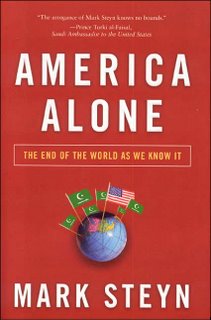 I got my copy of Mark Steyn's new book America Alone
 yesterday. It was not easy to get. I had been trying to get it for the past two weeks to no avail. Copies at Chapters/Indigo were nowhere to be found.
Apparently, Paul Well's book Right Side Up
 is also in short supply. However, none of this is an issue for Amazon.ca. They have both in stock so I ordered them together to qualify for free shipping and they arrived in three days.
Thanks Amazon.ca.
Saved by technology?
Claims that technology may provide the solution to climate change is subject to considerable ridicule. Yet without technology, the prospects of significantly reducing greenhouse gases and not killing the economy at the same time are remote. Fortunately, scientists and entrepreneurs are ignoring the naysayers and working to develop new and existing technologies to reduce the carbon imprint of our lifestyles.
For example, LEDs hold considerable promise in reducing future energy consumption:
In a similar vein, Amory Lovins has argued that by lightweighting our automobiles and switching to biofuels to run them, we could cut our oil consumption for automobile transportation to zero by 2040.
Closer to home, residential and commercial developers are working with firms such as Clean Energy Developments to tap growing consumer demand for clean energy systems. Technologies such as geothermal exchange can reduce a property's heating and cooling costs to a small fraction of traditional methods.
Taken singly, the impact of any of these methods alone is minimal. But cumulatively, it adds up.
Many promising technologies such as carbon sequestration in oil and gas, afforestation, and biomass-based energy are also being pursued. Our cause is certainly not hopeless, whether it is to reduce carbon or to wean ourselves from Middle-East oil. Ten years from now, we may even consider Kyoto to have been excessively unambitious. It won't happen overnight, but given sufficient time, the problems are not insurmountable. Scepticism about human ingenuity is understandable, but we may yet be saved by technology.
For example, LEDs hold considerable promise in reducing future energy consumption:
Light-emitting diodes will become economically attractive as replacements for conventional lightbulbs in about two years, a shift that could pave the way for massive electricity conservation, according to a researcher.
Right now, consumers and businesses can buy a light-emitting diode, or LED, that provides about the same level of illumination as an energy-hogging conventional 60-watt lightbulb, Steven DenBaars, a professor of material science at the University of California Santa Barbara, said at the SEMI NanoForum, taking place here this week. A principal advantage of the LED: It lasts about 100,000 hours, far longer than the conventional filament bulb.
Unfortunately, the LEDs that can perform this task cost about $60, he said. (Prices vary on the Internet.) But prices have been declining by 50 percent a year, so two years from now the same LED should cost around $20.
"At $20 the payback in energy occurs in about a year," DenBaars said. The rapid return on investment will occur in places such as stores and warehouses, where the light is on through much of the day. A year after that, LEDs will be even more economical for more places as costs continue to decline.Approximately 22 percent of the electricity consumed in the United States goes toward lighting, according to the U.S. Department of Energy
To make matters worse, traditional lightbulbs are incredibly inefficient. Only about 5 percent of the energy that goes into them turns into light. The majority gets dissipated as heat.
If 25 percent of the lightbulbs in the U.S. were converted to LEDs putting out 150 lumens per watt (higher than the commercial standard now), the U.S. as a whole could save $115 billion in utility costs, cumulatively, by 2025, said DenBaars, and it would alleviate the need to build 133 new coal-burning power stations.
In a similar vein, Amory Lovins has argued that by lightweighting our automobiles and switching to biofuels to run them, we could cut our oil consumption for automobile transportation to zero by 2040.
Closer to home, residential and commercial developers are working with firms such as Clean Energy Developments to tap growing consumer demand for clean energy systems. Technologies such as geothermal exchange can reduce a property's heating and cooling costs to a small fraction of traditional methods.
Taken singly, the impact of any of these methods alone is minimal. But cumulatively, it adds up.
Many promising technologies such as carbon sequestration in oil and gas, afforestation, and biomass-based energy are also being pursued. Our cause is certainly not hopeless, whether it is to reduce carbon or to wean ourselves from Middle-East oil. Ten years from now, we may even consider Kyoto to have been excessively unambitious. It won't happen overnight, but given sufficient time, the problems are not insurmountable. Scepticism about human ingenuity is understandable, but we may yet be saved by technology.
Thursday, November 02, 2006
Too many eggs in the income trust basket
Investors are understandably upset with the Conservative government's proposed tax on income trust distributions. Share prices for income trusts declined about 12% yesterday. A change in government policy, however, is one of the many risks of investing in the stock market.
That is why financial advisers routinely recommend a well-diversified portfolio with holdings across asset classes. Holding all your eggs in the income-trust basket is simply asking for trouble. Consequently, it is hard to feel sorry for people like this guy:
With any policy change, it is inevitable that some people will benefit and some people will get hurt. But this guy has clearly ignored the basic tenets of portfolio diversification: don’t put all your eggs in one basket. Rather than blaming the government, people should be taking it up with their financial advisor since it was common knowledge that something would have to give, particularly once BCE announced its intention to convert to the income trust structure.
In my view, Flaherty's decision on income trusts was a bold and brilliant move. Basically, it levels the playing field between corporations and income trusts, without raising the overall tax burden. At the same time, Canadian taxpayers will no longer be subsidizing foreign investors in Canadian income trusts.
Unlike Ralph Goodale, the previous Liberal Finance Minister, Flaherty acted quickly and decisively on this issue. Canada now has a tax policy that will require CEOs to focus on creating shareholder value the traditional way—by succeeding in the marketplace—rather than through financial and tax legerdemain. For seniors and other income trust investors, the damage is smartly mitigated by a phase-in period for existing trusts and income-splitting measures for pensioners.
Still, those investors affected by the change need to realize that their cash flows from income trust investments will not change very much if they were already being taxed at the personal level. While the decline in income trust share prices will hurt when it comes time to draw upon one's capital in late-retirement years, effective yields have now gone up (since the shares are less attractive to non-taxable and foreign investors and prices have gone down), which is good for those making new investments in existing income trusts.
The fallout from this decision illustrates one of the pitfalls of DIY investing. Too many investors, regrettably many of them seniors, do not seem to be cognisant of the investment risks of their portfolios. Yet they manage portfolios worth hundreds of thousands of dollars or more by themselves. While the yields on income trusts may seem attractive, there is a reason for it – they are risky investments, not GICs. Putting all your money in the income trust basket is not a very prudent approach to take in managing one's retirement savings. Any responsible financial advisor will tell you that. The government may make a convenient scapegoat for your incompetence, but ultimately, if you got hurt, you have only yourself to blame.
That is why financial advisers routinely recommend a well-diversified portfolio with holdings across asset classes. Holding all your eggs in the income-trust basket is simply asking for trouble. Consequently, it is hard to feel sorry for people like this guy:
Richard Milne, 74, who has invested most of his family’s savings in income trusts, estimated his losses following Tuesday’s tax decision at $50,000, although he says he hopes for some rebound. "They reneged on their promise," he said. "That really upsets me."
With any policy change, it is inevitable that some people will benefit and some people will get hurt. But this guy has clearly ignored the basic tenets of portfolio diversification: don’t put all your eggs in one basket. Rather than blaming the government, people should be taking it up with their financial advisor since it was common knowledge that something would have to give, particularly once BCE announced its intention to convert to the income trust structure.
In my view, Flaherty's decision on income trusts was a bold and brilliant move. Basically, it levels the playing field between corporations and income trusts, without raising the overall tax burden. At the same time, Canadian taxpayers will no longer be subsidizing foreign investors in Canadian income trusts.
Unlike Ralph Goodale, the previous Liberal Finance Minister, Flaherty acted quickly and decisively on this issue. Canada now has a tax policy that will require CEOs to focus on creating shareholder value the traditional way—by succeeding in the marketplace—rather than through financial and tax legerdemain. For seniors and other income trust investors, the damage is smartly mitigated by a phase-in period for existing trusts and income-splitting measures for pensioners.
Still, those investors affected by the change need to realize that their cash flows from income trust investments will not change very much if they were already being taxed at the personal level. While the decline in income trust share prices will hurt when it comes time to draw upon one's capital in late-retirement years, effective yields have now gone up (since the shares are less attractive to non-taxable and foreign investors and prices have gone down), which is good for those making new investments in existing income trusts.
The fallout from this decision illustrates one of the pitfalls of DIY investing. Too many investors, regrettably many of them seniors, do not seem to be cognisant of the investment risks of their portfolios. Yet they manage portfolios worth hundreds of thousands of dollars or more by themselves. While the yields on income trusts may seem attractive, there is a reason for it – they are risky investments, not GICs. Putting all your money in the income trust basket is not a very prudent approach to take in managing one's retirement savings. Any responsible financial advisor will tell you that. The government may make a convenient scapegoat for your incompetence, but ultimately, if you got hurt, you have only yourself to blame.
Friday, October 27, 2006
Eight years of the National Post
I posted earlier on today's most important birthday, but overlooked another important anniversary. The National Post is eight years old today (h/t: Paul Wells).
Congratulations to the editors and writers of the Post for providing the most interesting daily read in Canada. Without doubt, it is the best newspaper in Canada. The wide range of commentary and its balanced coverage, combined with its centre-right editorial perspective, make it unique in Canada -- it is a paper you can trust.
I've been a National Post subscriber since the beginning and keep the little acrylic tombstone with an encased replica of the front page of the inaugural edition I received on its launch on my bookcase. Fortunately, the paper is getting even better. They have been bulking up on their coverage of local Toronto issues, as well as sports, in a bid to become the only paper Torontonians need to read. If you are not reading it, try it out with a free 90-day trial subscription here.
Congratulations to the editors and writers of the Post for providing the most interesting daily read in Canada. Without doubt, it is the best newspaper in Canada. The wide range of commentary and its balanced coverage, combined with its centre-right editorial perspective, make it unique in Canada -- it is a paper you can trust.
I've been a National Post subscriber since the beginning and keep the little acrylic tombstone with an encased replica of the front page of the inaugural edition I received on its launch on my bookcase. Fortunately, the paper is getting even better. They have been bulking up on their coverage of local Toronto issues, as well as sports, in a bid to become the only paper Torontonians need to read. If you are not reading it, try it out with a free 90-day trial subscription here.
Happy Birthday Kid!
 It's hard to believe. My little baby is now a teenager. It certainly has been fun.
Happy
birthday
kid!
birthday
kid!
Thursday, October 26, 2006
Not so scary
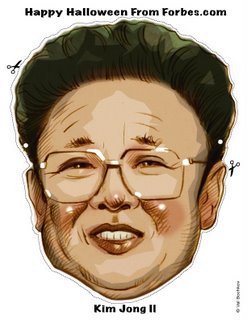 After all the talk about how scary Stephen Harper was in the last election, I figured we would be seeing lots of Stephen Harper costumes this Halloween. Somehow, I don't think this will be the case. Canadians don't find him all that scary.
Still, that hasn't stopped some from searching for a Stephen Harper mask. Too bad for her, I don't think she will find one. I was out shopping with my daughter for Halloween costumes yesterday at Malabar and while they had plenty of Frankenstein and George Bush masks, Stephen Harper didn't make the cut.
For those of you looking for other celebrity mask ideas for Halloween, check out Forbes. They've got masks for Kim Jong II, Stephen Colbert, Hugo Chavez and Katie Couric, among others, that you can print out and wear on Halloween. Now some of these guys are really scary.
Monday, October 16, 2006
Making a committment to the Toronto newspaper market
 For the second time in a week, the National Post was not on my doorstep when I left for work this morning. Apparently, there was a "delay in production." This happens every couple of weeks and every time it happens, I buy a copy of the Globe and Mail to read on the subway to work since I can usually snag a copy of the Post at the office. This is not the way to run a newspaper.
The source of the problem seems to be that the National Post does not even have its own printing plant in its most important market. In an age of contracting out, that in itself, is not a problem. Many publications can be produced more efficiently at the specialized facilities of commercial printers. The issue for the National Post is that the newspaper is actually printed at the Toronto Star's production facilities. So when there are production difficulties with the Toronto Star, the National Post gets bumped.
If the National Post is to make a credible committment to the Toronto market, it must have first claim on a printing press. It cannot play second fiddle to a competitor publication to the detriment of its subscribers. In the process, it would quickly lay to rest recurring rumours of its impending demise.
Saturday, October 14, 2006
Beryl Wajsman's Civil Conservatism
Back in May 2005, I wrote about Beryl Wajsman in an article entitled An Honest Liberal? At the time, Wajsman had achieved a certain notoriety as one of the lunch guests at Chez Frank when an envelope of cash was passed by advertising executive Jean Brault to a Liberal Party worker. Although Wajsman was later vindicated by Gomery, Paul Martin kicked him out of the Liberal Party all the same. The action, however, was redundant. Wajsman had already quit the party in disgust.
Since that time, Wajsman has not faded into the woodwork. He keeps up a whirlwind pace writing commentary for the Institute for Public Affairs of Montreal of which he is president, started Barricades Magazine of which he is the publisher and hosts The Last Angry Man on Montreal’s 940 AM.
Wajsman's latest essay On Civil Conservatism is reprinted on The Conservative Voice. It is well worth the read.
Wajsman eloquently describes the inevitable descent of "industrial liberalism" into illiberalism:
Since that time, Wajsman has not faded into the woodwork. He keeps up a whirlwind pace writing commentary for the Institute for Public Affairs of Montreal of which he is president, started Barricades Magazine of which he is the publisher and hosts The Last Angry Man on Montreal’s 940 AM.
Wajsman's latest essay On Civil Conservatism is reprinted on The Conservative Voice. It is well worth the read.
Wajsman eloquently describes the inevitable descent of "industrial liberalism" into illiberalism:
It has been an article of faith that appeasing almost every demand of populist "rights" was the course for electoral success. Little thought was given to the legitimate limits of government intrusion. Less still to the efficacy of the policies proposed. Today's experiment always trumped yesterday's experience.In its place, Wajsman posits a civil conservatism which stands as a bulwark against the intrusions of the state:
It has resulted in an international retreat from reason in the face of a galloping excess of license. A license which not only threatens the economic viability of western nations, but has created a feckless and frivolous citizenry dependant on government largesse whose apathy compromises the most basic and cherished constitutional liberties through the verdicts of illiberal democracy returning government after government based on the lowest common denominator of greed.
The essence of civil conservatism lies in the belief that the organization of a commonweal is essential for the promotion of those qualities of co-operation and compassion without which the challenges of human existence would find even the most powerful among us quite desolate. That these nobler inclinations of man must triumph over our coarser instincts of competition and contempt so that we can continue our incontrovertible ascent from the jungles of barbarism.Read the rest. It is a philosophy to which I could easily subscribe. I like this guy.
However, though intuitively democratic, the civil conservative understands the need to restrain illiberal government intrusions with the bridle of constitutional liberty. That society exists to provide each of us with the just consideration to realize the full flower of our individual humanity. And the requisite freedom to express that humanity in our singular poetry and passions.
Friday, October 13, 2006
As Jan Wong was saying...
From the Montreal Gazette:
And La Presse:
Separatists oppose anglo superhospital
The Gazette
Published: Friday, October 13, 2006
A coalition of separatists wants the province to abandon plans for an English-language superhospital in Montreal.
The group says the government is wasting at least $3.6 billion by building two large hospitals. One of the sites is to be affiliated with the McGill University Health Centre and the other with the French-language Universite de Montreal.
The coalition says it's wrong to provide equal funding to the hospitals when a majority of McGill medical graduates leave Quebec to practise in Ontario or the U.S. It says the McGill version should receive only 12 per cent of the total budget, reflecting the percentage of anglophones in Montreal.
And La Presse:
Réflexe de l'homogénéité
Pour Mme Ollivier, les promesses de diversité dans la représentation du Parti québécois sont restées lettre morte. «Malheureusement, force est de constater que dans toutes les circonscriptions prenables, le vieux réflexe de l'homogénéité joue encore.»
Pour elle, «les candidatures annoncées dans les bonnes circonscriptions appartiennent toutes à la majorité démographique et des personnes de talent sont reléguées à des circonscriptions difficiles et peu favorables.»
Forest industry in crisis
Our sanctimony about the Americans telling us what to do with our forests during the softwood lumber dispute seems to have been misplaced. In our pique with the Americans, we missed the opportunity to reform the way we allocate timber on public lands. As it turns out, the Americans were right. Our timber allocation system is dysfunctional. Eastern Canadian forest workers are now paying the price.
With a softwood lumber agreement now in place, it is time to focus on developing a timber allocation system that responds to market signals rather than defies them. It might not be enough to head off future trade disputes with the United States, but it might help save some of the jobs we have left in the sector.
The biggest reason Eastern Canada's forest industry has lost almost every comparative advantage it ever enjoyed -- and there used to be many -- is politics. Governments have managed our forests to maximize jobs and minimize efficiency. The inherent risk of such a strategy is that eventually there are almost no jobs left to maximize.
With a softwood lumber agreement now in place, it is time to focus on developing a timber allocation system that responds to market signals rather than defies them. It might not be enough to head off future trade disputes with the United States, but it might help save some of the jobs we have left in the sector.
Thursday, September 28, 2006
Voting with their feet
Nothing makes me more sceptical than a consensus, particularly in regards to Quebec. So after the drubbing Jan Wong received for her infamous article on the Dawson shootings, I decided to investigate a little further. The fact that both Premier Charest and PM Harper have also piled on makes me doubly suspicious.
This is the passage that seems to offend almost everyone:
What Wong really seems to be probing, however clumsily, is the place that those who are not part of the francophone majority have in Quebec society today. It is certainly foolish to presume that this "otherness" is a driving factor behind the horrendous acts of Kimveer Gill, Marc Lépine or Valery Fabrikant. But is it really so farfetched to suggest that this might be a contributing element to their alienation?
What I find particularly troublesome about Wong's critics is the fact that her hypothesis is dismissed out of hand. They directly attack her, not her arguments. Even Denise Bombardier, a so-called moderate, said something to the effect that Wong had the right to say something stupid. Some defense.
The tendency to circle the wagons on the part of the Quebec intelligentsia whenever someone dares question Quebec is well known. Yet what credibility do a bunch of white francophone journalists, politicians and community leaders, with the odd token, fluently-bilingual anglo or ethnic thrown in for good measure, have when discussing how the province's minorities might feel about their place in Quebec?
To listen to them, Globe and Mail journalists such as Jan Wong or Margaret Wente hate Quebec. They are even accused of fomenting separatist sentiment in the province. But as they ask how could they say such spiteful things, they are oblivious to the fact that they are effectively proving Wong's point. If they are so easily offended by what a Toronto journalist might write, imagine how anglophones and non-francophone immigrants in Quebec might feel when they see their francophone neighbours sporting pins with the slogan "le Québec aux Québécois" or chanting such at the St-Jean Baptiste festivities on June 24th.
Eventually the message gets through. For his part, Jacques Parizeau's outrageous outburst on referendum night about "ethnics and money" was totally redundant. It was already painfully clear that his little country did not include them.
Behind all this psychobabble, though, is one real fact. If English-speakers in Quebec have little or no cause to feel marginalized, then why do they continue to leave the province in large numbers? While Quebec elites feign indignation, English-speaking Quebecers are voting with their feet and leaving the province.
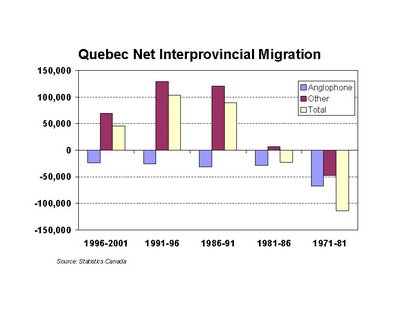
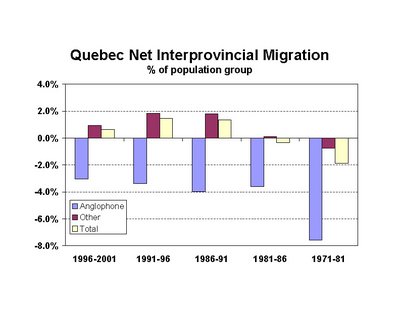 The number of people claiming English as their mother tongue in Quebec dropped more than 25% from 1971 to 2001. Over the same period, the total population of Quebec increased by 20.5%. In light of this apparent demographic mystery, perhaps a little more introspection about the society Quebecers want to build is in order.
This is the passage that seems to offend almost everyone:
What many outsiders don't realize is how alienating the decades-long linguistic struggle has been in the once-cosmopolitan city. It hasn't just taken a toll on long-time anglophones, it's affected immigrants, too. To be sure, the shootings in all three cases were carried out by mentally disturbed individuals. But what is also true is that in all three cases, the perpetrator was not pure laine, the argot for a “pure” francophone. Elsewhere, to talk of racial “purity” is repugnant. Not in Quebec.Now it is true that Montreal is more "cosmopolitan" in terms of its ethnic diversity than it once was. Still, relative to Toronto, Montreal has a long way to go. In 2001, visible minorities – the group that Dawson killer Kimveer Gill's family would be considered part of – comprised 13.6% of the population in the Montreal CMA, compared to 36.8% in Toronto. But linguistically it is another story as English is being progressively erased from the face and working life of the city.
What Wong really seems to be probing, however clumsily, is the place that those who are not part of the francophone majority have in Quebec society today. It is certainly foolish to presume that this "otherness" is a driving factor behind the horrendous acts of Kimveer Gill, Marc Lépine or Valery Fabrikant. But is it really so farfetched to suggest that this might be a contributing element to their alienation?
What I find particularly troublesome about Wong's critics is the fact that her hypothesis is dismissed out of hand. They directly attack her, not her arguments. Even Denise Bombardier, a so-called moderate, said something to the effect that Wong had the right to say something stupid. Some defense.
The tendency to circle the wagons on the part of the Quebec intelligentsia whenever someone dares question Quebec is well known. Yet what credibility do a bunch of white francophone journalists, politicians and community leaders, with the odd token, fluently-bilingual anglo or ethnic thrown in for good measure, have when discussing how the province's minorities might feel about their place in Quebec?
To listen to them, Globe and Mail journalists such as Jan Wong or Margaret Wente hate Quebec. They are even accused of fomenting separatist sentiment in the province. But as they ask how could they say such spiteful things, they are oblivious to the fact that they are effectively proving Wong's point. If they are so easily offended by what a Toronto journalist might write, imagine how anglophones and non-francophone immigrants in Quebec might feel when they see their francophone neighbours sporting pins with the slogan "le Québec aux Québécois" or chanting such at the St-Jean Baptiste festivities on June 24th.
Eventually the message gets through. For his part, Jacques Parizeau's outrageous outburst on referendum night about "ethnics and money" was totally redundant. It was already painfully clear that his little country did not include them.
Behind all this psychobabble, though, is one real fact. If English-speakers in Quebec have little or no cause to feel marginalized, then why do they continue to leave the province in large numbers? While Quebec elites feign indignation, English-speaking Quebecers are voting with their feet and leaving the province.

 The number of people claiming English as their mother tongue in Quebec dropped more than 25% from 1971 to 2001. Over the same period, the total population of Quebec increased by 20.5%. In light of this apparent demographic mystery, perhaps a little more introspection about the society Quebecers want to build is in order.
Thursday, September 21, 2006
West Toronto Conservative Pub Night Tonight

You are invited to
The West Toronto Conservative
Pub Night
The West Toronto Conservative
Pub Night
Thursday, September 21st
7.00 PM start
The Dark Horse pub is located about half a block east of Jane Street on the south side of Bloor. Click here for a map of the location.Blogging Tories, CPC members and fellow travellers are all welcome. Hope to see you there.
Tuesday, September 19, 2006
Wal-Mart not organic enough for its critics
Wal-Mart's entry into the natural food business promises to lower organic food prices for consumers. Yet not everyone is happy. It seems that Wal-mart is not organic enough for its critics despite legitimizing the market and fueling growth for products such as organic milk.
Andrew Potter notes the absurdity of it all.
Activist groups, as well as some organic food retailers and dairies, contend that the company where Wal-Mart and the other big retailers get their milk operates large factory farms that are diluting the principles of organic agriculture and delivering customers a substandard product. They argue that Aurora’s cows do not spend any significant time roaming pastures and eating fresh grass; instead they live on a diet high in grains.
[...]
The controversy turns on how closely Aurora adheres to the principles behind the organic food movement. Many organic farmers say grass feeding is essential for organic dairy production because it is part of a cow’s natural behavior.
Andrew Potter notes the absurdity of it all.
Natural behaviour? Cows aren’t natural entities. Like dogs, they’re completely artificial. They’re basically living meat sculptures, shaped by humans, for human purposes, over thousands of years. Besides, who cares whether what they eat is part of their natural behaviour? You’re going to drink their milk. Once you’ve decided that you’re willing to swallow whatever comes out of a cow’s udder, you’ve pretty much abandoned any high ground on the “natural behaviour” front.I, for one, applaud Wal-Mart's expansion into natural foods if it means I no longer have to set foot in an over-priced "health food" store again. That's a healthy development in my book.
Does the Toronto Star know about this?
I find it rather hard to believe that the Toronto Star missed this one:
Fortunately, Google didn't. Now where can I get a gun?
Stephen Harper's "Quisling" government pursues further talks for U.S. take-over of Canada
by Don Nordin
September 16, 2006
The Canadian
Media organization elites cover-up the biggest scandal in Canadian history
What would you think if it was announced that Canada was to cease as an independent country as early as 2007? Would it matter to you? Would you want to know who was responsible? What would you do?
Well, during the last week there have been announcements from at least two sources that Canada will soon cease to exist as a sovereign country.
Fortunately, Google didn't. Now where can I get a gun?
Captain Capitalism to the rescue
In a similar vein to Kate's advice on how to talk to your lefty friends about guns, Captain Capitalism comes to the rescue with the antidote to leftist conspiracy theories – REALITY.
I think he's on to something.
Are you sick and tired of the other kids on the block regurgitating their bumper sticker sound bytes about how Bush orchestrated the drop in oil prices for the election?
Tired of stupid, brainwashed leftist whiners going out of their way to abandon all rational thinking and logic so they can get their jollies off of subscribing to outlandish conspiracy theories?
Sickened by the utter hypocrisy of socialists who will disregard the pursuit of the truth and the well-being of the nation in order to make themselves feel like intellectuals and espouse ridiculous levels of stupidity?
Well, sit there in utter silence with your jaw on the floor as you cannot comprehend their stupidity no more when you hit them buck-side the back of their head with…(dun dun DUUUUNNNNN!)
Captain Capitalism’s REALITY!
I think he's on to something.
Subscribe to:
Posts (Atom)