Wednesday, January 11, 2006

Gomery's unlimited mandate

One thing that really jumped out at me during last night's French debate was Paul Martin's assertion that he gave Justice John Gomery an unlimited mandate with unlimited resources to investigate Liberal government wrong doing.

Je l'ai donné un mandat illimité, des ressources illimités...

Really?

You can watch his statement in French by clicking the first clip in the Gouvernance et éthique section and advancing to about the 1:20 mark.

Tuesday, December 20, 2005

Only in Canada...

Elton John is getting married tomorrow. At least that is what the papers would lead you to believe. Elton and his Canadian partner David Furnish indeed plan to tie the knot, but they are not getting “married.”

Under Britain’s Civil Partnership Act 2004, same sex couples will be permitted to enter into civil partnerships beginning December 21, 2005. The act, however, says nothing about gay marriage. Nonetheless, the reviews from UK’s gay and lesbian community are generally positive.

Canadian-born film-maker Furnish said the act was "hugely significant" for society.

"It is one of the defining issues of our times," he said.

"And I applaud Britain for embracing the diversity of our society."


Here in Canada, Conservative Party of Canada leader Stephen Harper continues to be vilified for proposing essentially the same thing.

Only in Canada you say? Pity.

Thursday, December 08, 2005

Smoking gun

The initial accusation that the Finance Department leaked inside information about imminent changes to the taxation of income trusts and dividends, while compelling, lacked any real evidence. In that context, Finance Minister Goodale's explanation that suspicious market activity was merely speculation was plausible, if not convincing.

All that has changed now that evidence has surfaced about a senior advisor in the Finance Department calling CARP, an advocacy group for Canadians over 50, to notify them of a policy announcement later that day with the unspoken understanding that they would get what they wanted on income trusts.

The chart below shows the S&P Canadian Income Trust Index (^GSPRTCM) rising in the second half of the trading day, particularly just before the close, relative to the overall TSX Index (^GSPTSE). The movement in some individual issues, where trading volumes sky-rocketed, is even more pronounced.


Notwithstanding recent backtracking by CARP, there is now enough smoke for the Ontario Securities Commission to investigate allegations of insider trading. Ralph Goodale has some explaining to do.

Where's the PM?

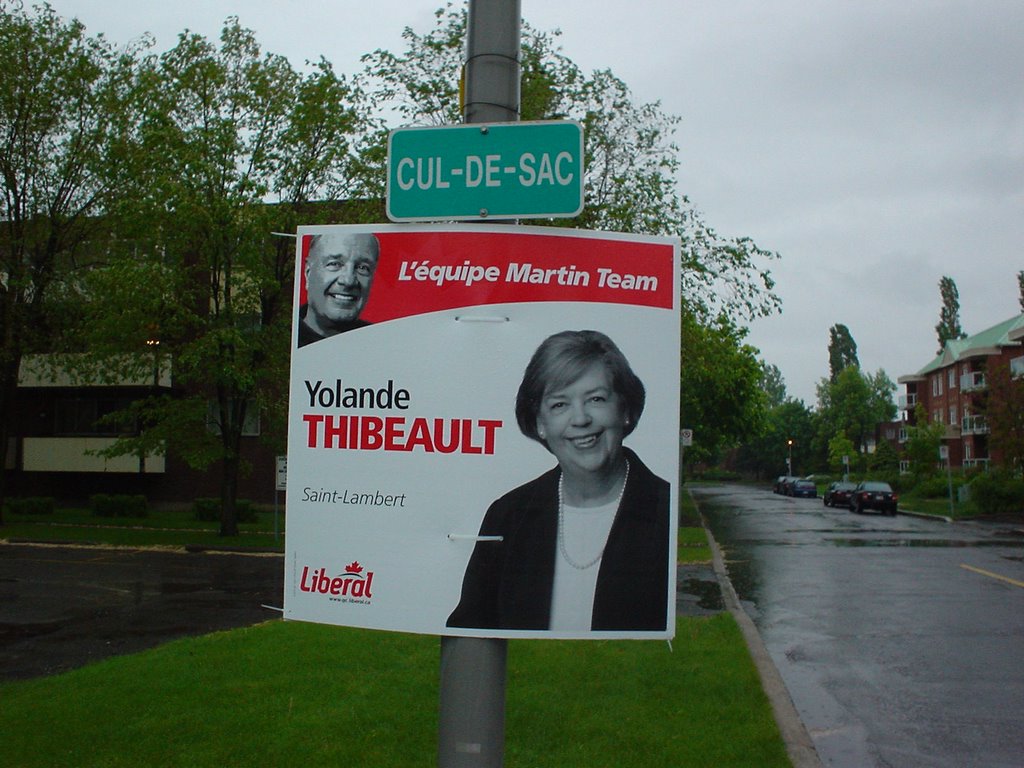
Last election, the Liberals tried to rebrand themselves as Team Martin or L'équipe Martin in Quebec. Despite their efforts, the strategy only had limited success. For some candidates such as Yolande Thibeault (see photo from the last election below), the stench of AdScam was simply too strong to overcome, as they went down to well-deserved defeat.

This election, the Liberals seem to be doing all they can to distance themselves from Paul Martin, as well as their own party. The vacillating, flip-flopping, Liberal leader is no longer the asset they thought he was. For example, the campaign pamphlet I received from local Liberal candidate Sarmite Bulte does not mention Martin's name at all, while the Liberal logo on the pamphlet is dwarfed by her name.
With unintended irony, the Liberals seem to be playing their own version of Where's Waldo? with a "where's the PM?" button on the front page of their site (h/t, Warren K). Mention of Paul Martin's name is typically several pages deep on the candidates sites I have visited. Some candidates don't even mention his name at all.

Somehow I think the Liberals are going to have a hard time playing the "Stephen Harper is scary" card when they are afraid of their own leader.

Monday, December 05, 2005

And why is that?

Duceppe...said he doesn't necessarily want to see a Conservative government led by Stephen Harper.

Gilles Duceppe and other Quebec sovereignists are salivating at the possibility of another Liberal minority or majority government. Such an outcome would be rightly viewed as a snub to Quebec and put in place a key winning condition for a future, successful referendum on Quebec independence.

Quebecers are deeply embarrassed by the sponsorship scandal. Not only does it reflect badly on the Liberal government, it reflects badly on them. That is why they will massively reject Paul Martin’s Liberals in the upcoming election.

Gilles Duceppe knows that if the rest of Canada re-elects the federal Liberals, his dream of an independent Quebec is at hand. Maybe it’s time for the rest of us to pull our heads out of the sand.

Monday, November 21, 2005

Liberal Influence Peddling

Don't you just love it when Liberals rat on their own? The principals at TDH Strategies are obviously not welcome in the Paul Martin camp. One of their posts today highlights the questionable connections between Martin operative Erik Bornman and Dave Basi.

The search-warrant "information to obtain" or ITO released by police in September, 2004 claim that Bornman offered provincial ministerial aides Dave Basi and Bob Virk a benefit -- help in obtaining $100,000-plus jobs with the federal Liberal government -- in exchange for obtaining confidential information about the BC Rail deals.

Yesterday, the federal Liberal riding association for Saanich-Gulf Islands had their nomination meeting to choose their candidate for the upcoming federal election. The race between Jag Dhanowa and former Liberal MLA Sheila Orr had become bitter, largely because of disputes over what Orr supporters referred to as the "instant Liberals" who have supported Dhanowa in the past.

Orr ended up winning by 71 votes, but the most fascinating thing about the entire affair was the appearance of Dave Basi, the central figure in the police raids and a man now charged with breach of trust, accepting a bribe to influence government business (from none other than Erik Bornman) and fraud over $5,000. Basi brought a significant amount of members out to support Dhanowa.


Plus ça change...

Saturday, November 19, 2005

DIY election platforms

In a recent musing, Warren Kinsella characterizes Toronto Star columnist Jim Travers as "one of PMO's last remaining messenger boys." And yet in today's column, Travers lays out the reasons to throw the Martin gang out.

In a subtle dig at Kinsella, Travers calls it the century's "first do-it-yourself election." Kinsella, of course, waxes poetic in his recent book Fury’s Hour about DIY culture in the punk movement.

Travers comes up with these gems:

… democracy only works when votes are used as sticks to beat discipline into politicians who mistake the public purse for their own.

[…]

After years of demonizing Conservatives as secret agents for Ralph Klein and two-tier health care, Liberals are suddenly silent as Jean Charest speeds the country toward different systems for rich and poor. Even a watershed Supreme Court decision undermining Ottawa's health insurance monopoly has left strangely speechless a government more concerned with repairing its ruined Quebec brand than defending public health care.

[…]

Martin believes in asymmetrical federalism but, apparently, not enough to debate or defend it. Canada is under renovation without a blueprint and that justifies showing Liberals the door.

[…]

Decisions are tightly held in Martin's innermost circle, the promise to make MPs strong enough to do their job is broken, and tracking how taxes are spent is as intentionally difficult as ever.

Canadians recognize the problem and are applying a solution. They treat the federal government with the disdain it's earned and, come election day, record numbers will vote with their feet by staying home.

The few who still care have no shortage of other planks to build their DIY-platforms. From protecting privacy to reaching the Canada-created international aid threshold, there is plenty of rough stuff to finish the job.Now seems a good time to start.

Even Kinsella can't argue with that.

Thursday, November 17, 2005

Let them go?

It is little wonder the CPC is on life support in Quebec if these views are representative of CPC party and Blogging Tories members.

Loyalist, in his post Boisclair: Maintient-Il Le Droit? argues:

If Quebec thinks that the rest of Canada is stifling its rightful aspirations, it's doing the same to ours as well.

Let's hope that Boisclair leads the PQ to victory, in the next election and referendum. Because if the choice is between Quebec or Alberta leaving, we know whose departure would weaken Canada the most, economically, politically, and culturally.


And in the comments, Warwick weighs in with:

Let Quebec go willingly. If not, invite them to leave. This country has not been viable since the beginning. Quebec has been dragging us down since we started letting them. They cost too much for the little good they do.

Let them drown in their own socialism - without us paying for it.

My sympathy for Quebec has reached into negative numbers. Be gone.


Such talk is not only offensive, it is down right counterproductive. No party can win a majority government without seats in Quebec. Moreover, if you want to bring more Ontarians into the fold, then playing the national disunity card is just plain stupid.

Smarten up guys.

Tuesday, November 15, 2005

She's Brian's Mom

I thought she looked familiar. She's Brian's mom!


Listen to her here.

Big Brother Paul


Michael Geist highlights the shortcomings of Bill C-74, the Modernization of Investigative Techniques Act, on his blog today. He concludes:

Canadians deserve better. They deserve real judicial oversight before their personal information is disclosed and, given the costs (financial and otherwise) they deserve a full accounting on why this bill is needed.


If this thing passes, you can forget about your privacy. Big Brother Paul will be watching.

Think harder

So:

Prime Minister Paul Martin says he can't think of anyone who wants a Christmas election campaign except for the three opposition leaders.


I can think of at least one.

Monday, November 14, 2005

The Toronto (Star) Consensus

After having lived in Quebec for most of the past fifteen years I naturally become suspicious whenever it is asserted that everyone agrees on an issue. More times than not, I found myself on the other side of the issue that all Quebecers supposedly agreed on. Whether it was on fiscal imbalance, the language laws or the clarity act, somehow the so-called consensus usually excluded me.

For some reason, I thought it would be different when I moved to Ontario. Little did I realize that claiming a consensus is a common rhetorical device used to marginalize one’s political opponents on this side of the Ottawa River as well. Take this recent book review in yesterday’s Toronto Star:

There are occasions you realize everybody in your community agrees on almost everything.

Sometimes this can be terrifying, but most times there's a certain comfort to be taken when most everyone agrees that certain things — say gay marriage, access to abortion and the legalization of marijuana — are all desirables.


Now personally, I cannot really say I am in fundamental disagreement with any of these things. In fact, I have even been an advocate for one of them. But only willful ignorance can lead one to be blind to the fact that many Canadians do disagree with them. Moreover, I fail to understand how pretending that defensible, opposing views do not exist actually advances one’s cause.

Unfortunately, disrespect for opposing viewpoints seems to be increasingly common in Canadian political discourse. Instead of attempting to bridge the gaps and forging a true, workable consensus, we have been prone to divisive and destructive debates.

For example, same-sex marriage may now be the law in this country to the evident pleasure of its supporters. But the attempt to demonize not only those who opposed the bill, but even those who were simply uncomfortable with it did not win over people to the cause. Ultimately, this winner-takes-all approach not only leads to bad policy, it also undermines support for the laws that do get passed.

Sunday, November 06, 2005

You too can be a Registered Lobbyist

Taking my cue from Scott Reid’s comments on Friday, I took the initial step to register as a lobbyist.

Scott Reid…said lobbying is legally defined as trying to influence public policy.


It's better to be safe than sorry. I have called my MP’s office in the past to provide my feedback on the public policy issues of the day. Moreover, my political opinions are now out in the open here at Nice Comfy Fur. What else is the purpose of calling one’s MP or writing a political blog if not to influence public policy?

You too can be a Registered Lobbyist by registering online at the Office of the Registrar of Lobbyists. It’s free.

Think of the benefits. You can call your MP or blog about political issues with impunity. As an added bonus, Scott Reid or Scott Brison can never make unfounded accusations about you not registering as a Lobbyist.


Update: To register as a lobbyist at the link above, you must first create an account. Scroll down the page and click Account Creation.

Saturday, November 05, 2005

We are all lobbyists

We are all lobbyists now, at least any of us with a political opinion that might be foolish enough to articulate it.

From Canada.com:

The government issued a press release alleging that Harper once worked as an unregistered lobbyist. The Liberals also asked the registrar of lobbyists to examine his former role with the National Citizens' Coalition.

"If Mr. Harper wants to play sheriff, he can start by slapping handcuffs on himself," said Prime Minister Paul Martin's spokesman, Scott Reid. He said lobbying is legally defined as trying to influence public policy - which Harper did with the NCC.


Now that everyone has that straight, it makes it all the more surprising that Liberals such as David Dingwall and Richard Mahoney failed to register as lobbyists for paid work they did trying to influence public policy on behalf of their clients.

I just knew blogging about Canadian politics was going to get me into trouble eventually. Anyone know where we are supposed to register?

Monday, October 31, 2005

Increased immigration and Canada's nuclear future

The federal Green Plan calls for Canada to reduce greenhouse gas emissions by 6% from 1990 levels by the 2008-2012 period, or more than 35% from the business-as-usual levels expected by that time. The reductions that the Canadian government agreed to are absolute, not on a per capita basis.

And yet, the Liberal government has just announced plans to raise immigration targets and open the door for 700,000 prospective immigrants.

Now we can debate the merits of either policy, but together they simply do not add up. Something has to give.

The credibility of Canada’s Kyoto commitments is already questionable. Adding another 300,000 immigrants per year by 2010 will lead to increased energy consumption, much of it derived from carbon-based fuels such as oil, coal and natural gas. Does this mean we are going to fire up the nuclear reactors to keep our word?

Spinning Gomery

The Liberal spin machine is out in full force in anticipation of the release of the first Gomery report this Tuesday. The conventional wisdom is that the report will be very damaging to the Liberal Party. Whatever Gomery may conclude about Paul Martin’s involvement in the AdScam scandal, Liberal operatives have been clearly implicated in a systematic kickback scheme for the benefit of the Liberal Party, as well as perhaps for themselves.

But let’s not let facts get in the way. Former Liberal strategist John Parisella seems to think that it is federalists in Quebec that will be hurt by Gomery’s conclusions (look for link here), as if Canadian federalism were the exclusive domain of the Liberal Party.

Granted, given the political dynamic in Quebec, the Liberal Party has been the federalist standard bearer in the province for the last dozen years. For most federalist-leaning Quebecers, there seemed little point in splitting the vote with other federalist parties if it meant they would otherwise be represented by the separatist Bloc Québécois.

However, that does not mean there are not other federalist options, only that, it was the Liberals who looked like they had the best shot at taking seats from the separatists ever since Kim Campbell led the post-Mulroney Conservatives to oblivion in 1993. The conclusions of Gomery report will undoubtedly lead to second thoughts among many Quebecers about ever voting Liberal again.

With the Bloc Québécois at 61% support, well ahead of support for sovereignty at just over half, a significant chunk of the federalist protest vote is without a home. Quebecers have not necessarily given up on federalism. But they have given up on the Liberal Party. Consequently, there is a tremendous opportunity for the CPC to tap into this discontent. Nonetheless, without a strong, grass roots organization, it will not be easy.  However, getting the tide to turn in Quebec will be the key to attaining a CPC majority in the future.

Thursday, October 27, 2005

Distracted by corruption reprise

Life has been keeping me busy with other things than blogging the last few months. But while my life has been progressing – I now live in a new city and have a new job – other things have, unfortunately, not changed.

The Conservatives are still screwing up.

They are so preoccupied with Liberal corruption that they are falling into behaviour similar to that which they condemn. Last time it was Grewal. This time it is Brian Pallister.

To help me ease back into this, I am going to reprint an earlier post from my Random Notes blog in early June, which the provider so thoughtfully decided to erase. The central point still holds: Canadians know the Liberals are corrupt, but if they are ever going to vote for the CPC, they want to know how the party will govern.

Distracted by corruption

Enough already. If Canadians have not figured out that the current Liberal government is corrupt, they don’t want to figure it out. There is more than enough evidence for any rational person to make up their mind about it. It is time to move on to other things.

The last thing the Conservatives need is to be making stuff up. All the credibility they have earned on the corruption issue is down the drain if the Grewal tapes have been doctored. All those tasty tidbits implicating Tim Murphy and Ujjal Dosanjh will be forgotten if it is true.

Once again the ball was in the Conservatives court and they hit it straight into the net. The Harper team is proving to be a bunch of amateurs. You cannot score points like that.

In my view, the Conservatives’ preoccupation with corruption is a big distraction. Sure, Canadians are concerned about Liberal corruption. But they also want good government.

Not being Liberal is not enough to get elected. Canadians want to know what you will do if you are elected – what you will do for Canadian families, what you will do to restore democracy and stop corruption, what you will do to deliver value for our tax dollars.

Given that more than half the electorate somehow considers the Conservatives to be “scary,” it is all the more imperative that you communicate your vision for the country. So what if the Liberals steal a few of your policies. If they adopt your policies, they can hardly accuse you of being scary.

It is going to take time for Canadians to become comfortable with the Conservatives. However, there will not be enough time if you wait for an election before telling Canadians what you are about. You have established that the Liberals are corrupt. Now is the time to talk about how you would govern.

Friday, July 15, 2005

Voter alienation and consumer sovereignty

Andrew Potter weighs in with an interesting perspective on voter alienation in a recent article in the Toronto Star.

Consider last summer's federal election. It was the most competitive in 15 years, but the substantial issues were overshadowed by the standard litany of grievances from the "alienated voter" corner of the room. This was the refrain: "there is no real difference between the political parties," "none of the parties speaks to me/reaches out to me/represents my views," "politicians always change their minds/never do what they say they will do," "my vote doesn't really matter anyway."

Yet one could argue that the disaffection of these supposedly "alienated" voters is a product of their having internalized the ideology of consumer sovereignty. They have confused the norms and expectations that govern the political arena with those that govern the marketplace. Fundamentally, what they dislike about politics is that it isn't more like shopping. When you go to the mall, obsequious salespeople will trip over themselves to find a product that is perfectly suited to your own particular needs and desires. We have become so accustomed to this sort of highly individualized service that some people, particularly the young, are tempted to wonder why their politicians can't be more like their favourite brands.

The problem is that in a democratic society, we seek to govern ourselves by consensus and agreement. This means political parties are necessarily charged with the task of creating platforms that reconcile, in some way, the opinions of millions of individual citizens. In a pluralistic and multicultural country, it is hardly surprising to find that there is very little overlap in these views. Thus, what political parties wind up presenting, in the way of a platform, cannot possibly be tailored to fit each individual's personal predilections. That's simply not how democratic politics works.

Potter is co-author of The Rebel Sell: Why the Culture Can't Be Jammed. The book just came out in paperback and is one of the first on my cottage reading list.

You can catch more of Potter's insights at the This Magazine Blog, where he is a regular contributor. Potter provides some welcome balance to the dominant leftish perspective of the other contributors to the blog.

Tuesday, July 12, 2005

Not afraid

I'm not sure what to make of a new web site called We’re not afraid! Created only five days ago in the wake of the London bombings, it seems to have struck a chord. People from all over the world are submitting pictures to the site with some sort of tag line asserting they are not afraid.

In typical fashion, though, the New York Times is dismissive of the whole exercise (registration required).

The site displays a range of defiant postures. Some people hold up their middle fingers, presumably for the terrorists to see. Some people posted pictures of American soldiers, presumably for Londoners and Americans to see.

But more and more, there's a brutish flaunting of wealth and leisure. Yesterday there were lots of pictures posted of smiling families at the beach and of people showing off their cars and vans. A picture from Italy shows a white sports car and comes with the caption: "Afraid? Why should we be afraid?"

A few days ago, We're Not Afraid might have been a comfort. Today, there's a hint of "What, me worry?" from Mad magazine days, but without the humor or the sarcasm. We're Not Afraid, set up to show solidarity with London, seems to be turning into a place where the haves of the world can show that they're not afraid of the have-nots.

But in face of such amorphous threats, what can we really do? Are we to stop living and cower in our basements? Are we to apologize for who we are?

And what's this about "have-nots?" We have been through this before. The majority of the 9-11 bombers were upper-middle class Saudis. Of course that inconvenient fact does not stop the New York Times from attempting to transform the London terrorist bombings into a class war.

While perhaps not the "root cause" behind the evident Islamist hatred of the West, we should consider whether such self-flagellation is a contributing factor. In blaming ourselves, we are in effect absolving the perpetrators of these inhuman acts of any responsibility.

Somehow, I do not think blaming ourselves will persuade the terrorists to stop. So maybe these people have it right. Defiance is a better strategy. If we show our fear, the terrorists have won.

Wednesday, July 06, 2005

Canada’s free-market traditions

In today’s National Post, Michel Kelly-Gagnon, president of the Montreal Economic Institute, reviews Canadian economic history and challenges the view "that interventionist government, high taxes, protectionist policies and socialized medicine constitute the very fabric of our national identity."

Two years ago, Americans celebrated the bicentenary of the famed Lewis and Clark expedition of 1803 to explore the Northwest. This expedition was funded by the U.S. Congress, at the request of president Thomas Jefferson. Few people know that whereas the U.S. government subsidized its westbound explorers, the Canadian West was explored by a private expedition paid for by private interests. Indeed, in Canada, during the 1770s, the North West Company and fur traders such as Alexander Mackenzie were moving their way to the Canadian West in search of profit, and without government money.

I think there is great symbolism to be found in that story. It contradicts the notion that U.S. history is all about private initiatives, and that Canada's history is nothing but a long succession of heavy government interventionism. This is simply not true. Actually, for many years, in many areas, it was the other way around. More and more distinguished scholars are showing us that it is a fabrication of our nationalist elites (and I mean both Canadian and Quebec nationalists) that you cannot be a "real Canadian" or a "real Quebecer" if you are opposed to statism and big government.


Our dependence on the all-encompassing, interventionist state is a relatively recent phenomenon. Despite what some would have us believe, the state is not what defines us as Canadians. Much of what we have accomplished as a nation has been through private initiative. Our free-market traditions have served us well in the past. They can provide guidance to the present and future as well.

Tuesday, July 05, 2005

CPC is “pro-market” not “pro-business”

In a recent post, ALW looks at the common assumption that Conservative Party policies “favour corporations at the expense of the little guy.” He notes that their success at soliciting electoral contributions from individual Canadians belies that view.

The CPC is a “pro-market” party. That is not the same as a “pro-business” party. Unfortunately, most Canadians do not seem to be able to make this distinction.

The Liberal Party is a corporatist party, that is, pro-large business. Their interests and those of many large corporations are intertwined. The implicit bargain has always been that government regulations and policies will be shaped to benefit their corporate benefactors.

One merely has to look at the list of corporate donors to Paul Martin’s leadership campaign and to the Liberal Party to see who the primary benefactors of Liberal policy largesse are. To be sure, the Bombardiers, the Schwarzes, the McCains, the Stronachs, the Aspers, the Desmaraises and the Irvings, among others, operate in largely competitive, often global, markets. But their financial success is due in no small part to governments tilting policy in their favour. Not surprisingly, they are all major donors to the Liberals. Curiously, the CPC has received little or nothing from most of these corporate titans.

The many subsidies and other political favours that do come their way are at the expense of the Canadian taxpayer and, ultimately, our standard of living. When political influence rather than market savvy becomes a key determinant of success, it is not surprising that Canada’s productivity performance has significantly lagged that of other developed countries. This is the inevitable outcome of Liberal corporatism when government, not the market, picks the “winners” in this country.

A key electoral challenge for the CPC in the months ahead is to convincingly address the false perception that they are somehow beholden to corporate interests. Canadians need to see how a pro-market orientation, in place of the current Liberal corporatist approach, would benefit them and their country. Until they do, we are stuck with Liberals.

Monday, July 04, 2005

If the shoe were on the other foot

This editorial in the Montreal Gazette today looks at the effect of prejudice against anglophones in Quebec on their potential electability.

The bad news for the province's ambitious anglophones is that being an anglo is apparently a far greater handicap to becoming premier of Quebec than is being homosexual, black or female. The good news is that most Quebecers do say they would be comfortable with an anglo premier, even francophones in sufficient majority to carry a referendum.

A survey for La Presse showed that 35 per cent of Quebecers say they would not want an anglophone as premier. This is significantly higher than the nine per cent opposed to a black premier, the mere four per cent against a woman premier, or the 11 per cent who would object to a gay premier.


Could you imagine the uproar if a similar poll in the “Rest of Canada” revealed that 35% of English-speaking Canadians would not vote for a francophone Prime Minister?

Friday, July 01, 2005

Moving Day

No, not me, but hundreds of thousands of Quebecers are moving today. In a triumph of bureaucratic “efficiency” over practicality, virtually all residential leases in Quebec expire on June 30th. That means for many Quebecers, Canada Day is a day for moving or helping friends move.

Essentially, moving day is a big peak-load problem that just happens to take place on Canada’s national holiday. In any event, most Quebecers are probably partied out after celebrating their own “national holiday” last week. If I was the cynical type, I’d say it was planned that way.

Movers in the province have been booked for months. While there are stories of opportunism and exploitation, my view is they are probably not charging enough. After all, you expect to pay more for roses on Valentine’s Day.

Montreal streets are now bustling with activity. Traffic has slowed to a crawl as double-parked moving vans block the streets. Some people are even rolling their furniture down the sidewalk as they do the apartment shuffle. They either waited too long before trying to book a moving van or could not afford the elevated rates.

To my fellow Quebecers, I hope your move goes smoothly. To my fellow Canadians, Happy Dominion Day!

Monday, June 27, 2005

China in turmoil (continued)

Part three of Tony Perkin’s excellent series on China’s growing pains and the challenges it faces adapting to the economic and political transformation it is undergoing has now been posted.

You can read my first post on the series here. In part three, Perkins completes his list of China’s seven sins.

Sin #5 National Religion

Non-state-sanctioned religious worship is outlawed in China. Unlike the Soviets, however, the Communist Party doesn’t try to completely wipe out religious denominations. It nationalizes them instead.

[...]

Religious freedom is a society’s most basic human right. Any truly open and free society allows for religiously informed moral argument in public debate, or severs itself from thousands years of developed wisdom and culture. The best way to kill the spirit of a people and rob them of their culture is to outlaw or confiscate their religion.


Remember Tibet? Or how about the Falun Gong?

Sin #6 The One-Child Depopulation Strategy

Forced abortions are common. Also, sons tend to be more highly valued than daughters, and female infanticide has become prevalent, especially in rural China where government offi cials rarely take action against offenders. This female infanticide then creates a scarcity of women, so when Chinese men reach marrying age, they often turn to purchasing wives from slave-traders who traffic in women from throughout Asia (especially Vietnam).

We object to the one-child policy because it robs Chinese families and society from the very elemental choice to participate in the creation of future generations at the level that their spirits and hearts desire.


This policy also ensures a ready supply of Chinese babies for adoption by childless Canadian couples.

Sin #7 Internet Censorship

It would be strange enough to live in a country of state-controlled media outlets that painted only the best possible picture of its governmental leaders, but it would be completely outrageous to live in a country that completely controlled how you used and what you could find on the internet.


Apparently, Perkins has no experience with the media in Canada. But at least the Canadian government has not yet tried to control our internet surfing. Still, it would not surprise me if the CRTC is working on it.