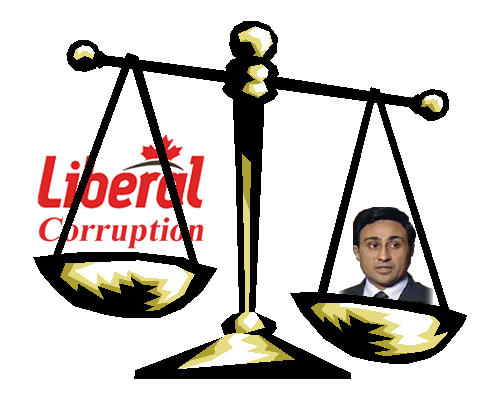
Monday, June 27, 2005

A pox on both your houses

Norman Spector’s column in the Globe and Mail today notes that after taking a closer look at our leaders, Canadians may decide that neither Stephen Harper nor Paul Martin deserve to win the next election.

In the Prime Minister, notwithstanding high expectations that preceded him for a decade, we find there's no there, there — just a chequebook in search of a headline. The principal reason Mr. Martin wanted Jean Chrétien's job so badly, it appears, is that he badly wanted Jean Chrétien's job.

[…]

Yet, even Mr. Martin's mantra in the wake of the Supreme Court decision on Canadians' No. 1 priority — “We're not going to have a two-tier health-care system in this country” — provoked barely a ripple in the media pond. One CBC talking head rebuked a Conservative for mentioning that Mr. Martin's physician runs private clinics, observing that the Prime Minister, too, pays with his medicare card — one reason two-tier health care is surging in Canada, and it certainly is not the solution.

To capture the essence of Mr. Martin's rhetoric, you have to refer to Harry G. Frankfurt, emeritus professor of philosophy at Princeton University. “On Bullshit,” a reprint of an academic paper the eminent professor Frankfurt wrote nearly 20 years ago, is a hit of the U.S. publishing season.

[…]

“For most people, the fact that a statement is false constitutes a reason ... not to make the statement. For St. Augustine's pure liar, it is ... a reason for making it. For the bullshitter, it is in itself neither a reason in favour nor a reason against. ... The bullshitter ... does not reject the authority of the truth, as the liar does ... he pays no attention to it at all.”


Mr. Harper's mistake was to have gotten caught up in the strategies and tactics of Parliament Hill. From the minute he mistook that superheated atmosphere for the real country, he was on his own agenda, not the voters'.

Sadly for Mr. Harper, he had been making some progress in increasing Canadians' comfort level with him and with his party's policies. However, instead of patiently continuing to hit singles, he swung for the fences and struck out, as sometimes happens.


So it comes down to this: in the next election Canadians must choose between a bullshitter and a strike-out king.

Making the grade at Comfy Fur U

Lorrie Goldstein’s Paul Martin For Dummies test helps Comfy Fur University students clarify where Paul Martin stands on the issues.

Here’s a sample question:

When Paul Martin voted in favour of the following motion in Parliament, "That, in the opinion of this House, it is necessary, in light of the public debate about recent court decisions, to state that marriage is and should remain the union of one man and one woman to the exclusion of all others, and that Parliament will take all necessary steps to preserve this definition of marriage in Canada," did he mean that:

(a) Marriage is the union of one man and one woman?

(b) Marriage is the union of one man and one woman, unless I have my fingers crossed?

(c) "Marriage" is such a vague term?

(d) What motion?
As Goldstein says, "Don't worry...there are no wrong answers."

h/t: Bourque Newswatch

Sunday, June 26, 2005

Experimenting with Blogger

This is a test to see how Blogger works. Sorry about the colours, but I am having a hell of a time editing the Blogger template.

I already have a blog called Random Notes. The service I use for that blog does have its shortcomings.

I have been moving over some of my recent posts. If I like this test, I will probably switch over.

Update: It's a go. I will be using this blog from now on.

Friday, June 24, 2005

China in turmoil?

Tony Perkins at Always On reflects on the rapid transformation of China and enumerates the seven sins which threaten peasant revolution and heighten risk for foreign investors.

In part one and part two of a three part series, he outlines the following sins:

Sin #1 Corporate and State Corruption and Thievery

Corruption is pervasive in China. Many state-owned companies have simply been stripped clean. In 2003 alone, officials said that the equivalent of nearly $8 billion was pilfered from state-owned enterprises.

[...]

Something is not right when a public market declines while GDP is exploding at 9.5%. The nation’s glaring cases of fraud, bribery, and embezzlement are also badly hindering the development of the China’s banking and financialsystems, which desperately need to be modernized for China to become a full-fledged economic superpower.

Sin #2 Weak Regulation and Inconsistent Legal Systems

Weak regulation and oversight, deep-seated government corruption, and poor risk-management practices are allowing fraud artists and looters to run off long before the investigators show up.

[...]

The “rule of law” concept, which in America includes ideas like criminal defense, runs contrary to China’s authoritarian roots.

Sin #3 Pirating Intellectual Property

Infringement of intellectual property has been rampant in China for many years. The International Intellectual Property Alliance in Washington states that about 95% of the DVDs sold in China are illegal copies. The latest Star Wars movie is already available on the streets of China for as low as 96 cents. Sellers do not even try to hide their trade, openly flaunting their wares in well-stocked storefronts. Steve Jobs tells a story of begging then-chief of Disney Michael Eisner to distribute and sell Jobs’s Pixar films in China for $1.00 a copy. “At least we would make some money,” Jobs said with exasperation.

[...]

It is a sad truth that media and software piracy is so entrenched in Chinese culture that it doesn’t feel like stealing. But it is, and as long as proper laws and IP enforcement mechanisms are absent, many foreign companies will remain reluctant to invest in China.

It is rather revealing, though, that Steve Jobs, once again, proposes a practical solution to the problem in contrast to the general intransigence of the media to changing their business models to adapt to the digital age.

Sin #4 China’s Bleak Environmental Outlook

In downtown Shanghai, the smog is sometimes so thick you can’t make out the building across the street. A World Bank report says that today, China is home to seven of the world’s 10 most polluted cities. In China’s heartland, the Yellow River, once known as the cradle of Chinese civilization, has in some areas been reduced to a trickle. According to the United Nations Development Program, for some 980 million Chinese, their main supply of drinking water is at least partially polluted.

[...]

The World Bank estimates that air pollution alone costs the Chinese economy $25 billion in health-care costs and lost working hours. It is also estimated that 8 to 10% of China’s GDP is offset by environmental damage. These rising costs, and the pilfering of natural resources, threaten to cancel out China’s future economic gains.

With part three yet to come, it has thus far been a very interesting read. I highly recommend the series.

In this age of globalization, low-cost Chinese production is integral to the economic activities of the western economies. Any disruption in China could have a profound impact on the global economy. For example, most consumer electronics products, as well as electronic components, are manufactured in China. Trouble in China could result to great turmoil in the global electronics industry and all that depend on it.

Consequently, it is of great concern as to how China deals with issues such as working conditions, child labour, environmental degradation, human rights, property rights, etc. China’s ability to responsibly and effectively cope with its growing pains affects us all.

Tuesday, June 21, 2005

The fur is starting to fly

Earlier today I left the following comment in response to Warren Kinsella respects Stephen Harper at Reasonable and Right:

Kinsella will always be a Liberal, but never a Martin Liberal.

The real story here is the underlying conflict within the Liberal Party. While we see fabricated stories about dumping Harper, there is a civil war going on in the Liberal Party.

The likes of Kinsella, Sheila Copps and Justin Trudeau are hoping that Martin loses the next election, so they can come out in the open and dump him. Giving advice (and it is good advice) to Harper is part of this plan. This [is] a struggle for control between the Chretien/Trudeau wing of the party and the Martinites.

Does the media pick up on this? Not a chance.


Of course we all know about Warren’s distaste for the Martin gang. But later I surfed over to Cherniak on Politics and read his piece The Board needs a shakeup, which is highly critical of the people surrounding Martin.

All that nice comfy fur really starts to fly when you get to the comments, with none other than Warren K leading them off. Evidently a lot of Liberals are not happy with Martin and his gang. What is it going to take for the MSM to run with this story – an open declaration of war?

The CPC and universal health care

Andrew at Bound By Gravity notes that the Conservatives have thus far been largely silent in the health care debate. Unfortunately, he suggests that you “[c]all Stephen Harper's office today and tell him that you're sick of the single tier medicare system, and that you want to hear the Conservative solution to our health care woes.”

In my view, the Conservatives should be vociferously supporting universal health care, not two-tier health care. Andrew is right, though, in arguing that the worst thing they can do is keep quiet. Ideally, the Conservatives should be talking about how they will make sure that all Canadians get the health care they need.

The fact that private health care is now an attractive option speaks to how the current system has been mismanaged and nothing more. While private care provides an important safety valve, it is not the answer to our problems.

There is a fundamental advantage to having a single-payer, universal health insurance system. The advantage is economic and moral.

Nonetheless, we should not preclude private options for those who so choose, but they must pay the full shot as do parents who choose to send their children to private schools (with the exception of Quebec which subsidizes private schools). I would add that doctors, who get much of their training at public expense, should also reimburse the government for the full costs of their training if they opt out of the public insurance system.

That said, the system we have now is clearly unsustainable. We need to explore other health care options. In particular, we must question the de facto monopoly public institutions have with respect to health care delivery. I believe we could realize significant economies with open competition between public and private providers for these services. No one would argue that a doctor in private practice is any worse or less efficient than a doctor in a public clinic. Similarly, why not encourage a little competition from the private sector for procedures such as hip replacements to keep the public sector honest?

Unfortunately, health care is a very emotional subject. While there are many things to discuss (nurse practitioners, co-payments, user fees, private medical accounts, etc.), the fact that it is a provincial jurisdiction is a possible reason for the federal Conservatives to steer clear of the debate. In reality, given the significant federal presence in funding the health care system, it is a debate that they cannot avoid without arousing very real suspicions about the CPC agenda.

In supporting universal health care, such suspicions about the Conservatives would be partly allayed. While it may not be necessary to get into the nuts and bolts of possible reforms, Canadians need to be reassured that they will get the health care they need under a Conservative government. Staying silent is the worst thing they can do.

Get out your credit cards

Private health care in Canada is now out of the closet. The highest standard of private medical care is now available to ordinary Canadians, at least to those who can pay for it.

For example, Paul “Two-tier” Martin has long received his medical care at a private clinic run by Medisys in Montreal. The company operates executive health clinics in Montreal, Toronto, Calgary and Vancouver, as well as more than a dozen medical imaging clinics.

Now that the genie is out of the bottle, we can expect to see a higher profile for private clinics and diagnostic services in the months ahead. Already, they are beginning to make their pitch directly to the public for new business.

Just the other day, Ville Marie PET/CT Centre placed an advertisement on page three in the Montreal Gazette. Unwittingly, the Gazette supplied the endorsement used by the company on its web page from an article published earlier this year:

“This is a matter of life and death. I’m not rolling in money, but why wait three months when you can have the PET scan done privately the next day?”

Unless Paul “It’s the charter stupid” Martin plans on using the notwithstanding clause to override the Supreme Court, there is no stuffing this genie back in the bottle.


Tombstone image generated at Tombstone Generator.
Hat tip: Warren K.

Thursday, June 16, 2005

Help elect the next Parti Quebecois leader

Montreal Gazette columnist Don MacPherson raises the possibility of a federalist takeover of the Parti Québecois.

The next leader of the PQ will be elected by a vote of all its members. And it's easy to join; it costs only $5, and you can (sign up on the PQ's Web site (www.pq.org) or download a mail-in membership form.

Membership is open to anyone over the age of 16. You don't even have to be a Quebec resident, and you need to understand only enough French to fill out the membership form.

And there's no way the PQ could stop federalists from joining – or a federalist candidate from running for the leadership.

In fact, the last time the PQ elected its leader by a vote of its members, in 1985, some Pequistes worried about just such a possible infiltration of their party by federalists.

The more legitimate candidates there are to split the vote of the real sovereignists in the PQ, the more it becomes possible for a federalist candidate supported by a block of federalist "instant Pequistes" to slip up the middle.


If I put my name in the ring, can I count on your support?

Tuesday, June 14, 2005

Fed pot a bust

Despite Canada’s international reputation for growing some of the most potent pot on the planet, CTV reports the federal government cannot quite get the hang of it.
In 2001, Ottawa awarded a company called Prairie Plant Systems an experimental contract to grow pot in the old mine shaft. The program was launched with a beaming Allan Rock, then the federal health minister, touring the facility.

"It's a great operation," Rock said at the time.

But four years, and $24 million worth of taxpayers' money later, critics say Ottawa's experiment in medicinal marijuana has been a disaster.

In that time, the federal program has harvested about 1,800 kilos of pot. Almost half of that is not up to standard for human consumption, according to Health Canada. So the unmarketable pot is sitting on ice, with your tax dollars being used to study the "long term stability of the product under storage conditions."

In the meantime, registered users of medical marijuana are sourcing their supplies through “compassion clubs” scattered throughout the country.

Before they waste another $24 million, the feds might consider hiring some local talent. Otherwise, they should watch a few episodes of Marijuana Man Grow Show on pot.tv, produced out of Vancouver.

Friday, June 10, 2005

The verdict is in


According to Decima CEO Bruce Anderson "Conservative strategy and broad public opinion preferences have recently been somewhat out of sync on election timing and on the Liberal-NDP budget changes. And, in the last week, the Grewal tapes have raised doubt about Conservative credibility and focus."

Wednesday, June 08, 2005

Cassette culture

A new book, Mix Tape: The Art of Cassette Culture, edited by Thurston Moore of Sonic Youth, explores the mix tape art form and laments its demise. Check out the review at Salon.com (you may have to watch an ad first).

In the days of my youth, I was an inveterate, mix-tape connoisseur, regularly mixing tapes of the best music from my record collection for my friends. Quite often they would return the favour. Sometimes the motivation was musical evangelism, other times it was to impress a girl.

Nowadays, the music I listen to is almost exclusively digital. For the most part, the core albums of my record collection have been upgraded to CD, some of them more than once, as the record companies repeatedly milk the upgrade cycle for all its worth by releasing a continuing stream of remasters and special editions.

After picking up a cassette deck at a garage sale last Saturday, I was looking forward to listening to some of my old mix tapes. Unfortunately, despite the assurances of the vendor, the tape deck did not work when I got it home.

In my view, the mix tape is a lost art form. A lot of love and attention goes into a good mix tape. From the careful selection of the music, to ensuring the right sentiments, to the song flow, to the transitions and finally to the packaging, whether it be a cool magazine photo montage, calligraphic script or chicken-scratch lettering. Dragging MP3s to an iPod list or burning them to a CD is not quite the same.

Although my best work has all been given away, I do have several mix tapes on hand. The set list of one of them follows below – a veritable musical time capsule.

Blood & Guts mix tape circa 1985

Side A

  1. Too Much Blood (Rolling Stones)
  2. Fun It (Queen)
  3. Smile Away (Paul McCartney)
  4. Panic in Detroit (David Bowie)
  5. Dangerous Rhythm (Ultravox)
  6. China Girl (Iggy Pop)
  7. Perspective (Peter Gabriel)
  8. Road To Nowhere (Talking Heads)
  9. This World Over (XTC)

Side B

  1. Night Train (James Brown)
  2. D.M.S.R. (Prince)
  3. Tenderness (General Public)
  4. E=mc2 (Big Audio Dynamite)
  5. Another Sad Story (The Boomtown Rats)
  6. Concrete Jungle (The Specials)
  7. Spiritual Healing (Toots & The Maytals)
  8. Close To Me (The Cure)
  9. Passion (Tulpa)
  10. One World (Dire Straits)

If you have a good mix tape kicking around, why not share the set list with us in the comment section.

Tuesday, June 07, 2005

Break the mould: legalize pot

If the Conservatives really wanted to break the mould, they would take Milton Friedman’s advice and legalize pot.

Milton Friedman leads a list of more than 500 economists from around the U.S. who today will publicly endorse a Harvard University economist's report on the costs of marijuana prohibition and the potential revenue gains from the U.S. government instead legalizing it and taxing its sale. Ending prohibition enforcement would save $7.7 billion in combined state and federal spending, the report says, while taxation would yield up to $6.2 billion a year.


Let’s face it, prohibition does not work. It did not work for alcohol in the 1920s and it has never worked for pot. By keeping marijuana illegal, we are only enriching the criminal organizations that supply the demand.

There is a strong conservative tradition supporting the legalization of marijuana. The economists endorsing the recent report from the Marijuana Policy Project merely add to the chorus. The Economist has long argued the case for legalization. Even Canada’s Fraser Institute, while not officially endorsing the position, published a report last year by Simon Fraser University economist Stephen T. Easton advocating the end of prohibition.

Admittedly, it would be a bold move for the Conservatives to come out in favour of legalizing marijuana. But in a stroke, it would cause a fundamental shift in the perception of the Conservative party on so-called social issues, as well as on its alleged willingness to take orders from the United States.

There is a large constituency of fiscal conservatives uncomfortable with elements of the Conservatives’ social agenda who would welcome a new approach to Canada’s marijuana laws. Many baby boomers still partake on occasion. Moreover, pot consumption among young adults, many who would not otherwise vote Conservative, is at all-time record highs.

One particularly interesting effect of supporting the legalization of pot is it would make turncoat, moderate Belinda Stronach look like a hard liner. Stronach is a staunch opponent of decriminalizing marijuana, largely out of concern about U.S. disapproval. By supporting a policy that is true to conservative principles, the Conservatives would neutralize the effect of Stronach’s defection, while encouraging Canadians to take a closer look at an agenda which is neither hidden nor scary.

Sunday, June 05, 2005

“The Mount Everest of arrogance”

With even the Toronto Star now seeming to take notice of the Liberal Party’s ethical lapses, we may indeed be nearing the tipping point at which Canadians finally reject Paul Martin’s Liberal government, en masse.

Two recent columns, by Star columnists Jim Travers and Chantal Hébert, have come down particularly harshly on Paul Martin.

Jim Travers argues that the Liberals have become arrogant and their culture of corruption stems from being in power for too long.

Paul Martin insists his new Liberals are attacking the problem at its roots by ending sponsorships, ordering the inquiry and pursuing criminals into court. Bunk.

Culture and structure are this problem's twin pillars and Liberal hegemony suggests neither one will crack soon.

For that to happen, a party that prides itself on being the Western world's most successful must first concede that the country is strong enough to survive a few years under other guidance and then ensure the civil service answers to Canadians, not its political masters.

Instead, Martin's clique is weakening the federation by widening regional divisions even as it prepares to fight another election, arguing that there is something worse than corrupt government: Conservatives. Meanwhile, the next election will come and go before anyone fixes what's so obviously wrong.


He concludes:

Hard as it is for Liberals to accept, sponsorship corruption, ethical failings and the crass determination to hold power by any means all find their genesis in the arrogance of a party that believes that it not only has the answers, it is the answer.

When a notion that false and arrogant becomes entrenched in a partisan psyche, any offence, all rules broken, every dollar stolen are excusable as the cost of pursuing the greater good. In that black-is-white universe, a government whose simplistic policies and thieving practices restoked separatism's fires positions itself as all that stands between unity and chaos.

That's the Mount Everest of arrogance and the deadliest of political sins.


Similarly, Chantal Hébert questions Paul Martin’s lack of moral fibre and whether his government would have acted any differently than Chrétien if faced with another national unity crisis.

The fact is, over the past few months the Prime Minister has compounded the damage wreaked on the credibility of Canada's political class by his predecessor.

Bridges between the government and the opposition were ordered burned as part of a parliamentary procedural war. Merit was shown to come a poor second to naked partisan interest in the allocation of government responsibilities. Deniability was given precedence over accountability.

The democratic deficit Martin so likes to wax lyrical about has been compounded into an ethical one. And past sins of omission and/or commission have been overshadowed by current, in-your-face transgressions.

If the Prime Minister is willing to fudge so many lines as part of a mere parliamentary showdown, what of a full-fledged unity crisis?


Some of Martin's cabinet loyalists are now quietly questioning whether their loyalty to him is in conflict with their duty to the country — and so probably should the rest of us.


The cracks in Martin’s leadership are widening. He may have won the last battle, but more and more it is looking like he is losing the war.

Friday, June 03, 2005

When the bubble bursts

Housing markets go through cycles. And the Canadian housing market has been on an upcycle for some time now. The risk of the bubble bursting is greater than some people think.

First, the run up in house prices has been driven largely by low interest rates. Any significant uptick in interest rates will have an immediate impact on affordability and will signal that the upcycle is over.

It is at this point that speculators will desert the market. Sellers, previously waiting for even higher prices, will rush to market realizing it is now or never, while potential home buyers will no longer feel the pressure to get into the market before it gets away from them. If interest rates do rise, then some sort of correction is all but inevitable.

Second, affordability in Canada is not all that good at present, despite protestations to the contrary. According to the Royal Bank’s latest Housing Affordability Index, the median household in Canada would be ineligible for a mortgage, on the basis of income, for a standard 1,200 square-foot bungalow, assuming they could come up with the 25% down payment in the first place.

Finally, I find it rather curious that Royal Bank now sees fit to expand its affordability index to include condos and townhouses, as if to prove that the market is still affordable. Nevertheless, our mythical median household would still be priced out the market for a 1,000 square-foot townhouse in Toronto and Vancouver. With their large mortgage portfolio, this attempt to massage the numbers to show the market is still affordable can only be interpreted as yet another sign that the market is peaking.

Distracted by corruption

Enough already. If Canadians have not figured out that the current Liberal government is corrupt, they don’t want to figure it out. There is more than enough evidence for any rational person to make up their mind about it. It is time to move on to other things.

The last thing the Conservatives need is to be making stuff up. All the credibility they have earned on the corruption issue is down the drain if the Grewal tapes have been doctored. All those tasty tidbits implicating Tim Murphy and Ujjal Dosanjh will be forgotten if it is true.

Once again the ball was in the Conservatives court and they hit it straight into the net. The Harper team is proving to be a bunch of amateurs. You cannot score points like that.

In my view, the Conservatives’ preoccupation with corruption is a big distraction. Sure, Canadians are concerned about Liberal corruption. But they also want good government.

Not being Liberal is not enough to get elected. Canadians want to know what you will do if you are elected – what you will do for Canadian families, what you will do to restore democracy and stop corruption, what you will do to deliver value for our tax dollars.

Given that more than half the electorate somehow considers the Conservatives to be “scary,” it is all the more imperative that you communicate your vision for the country. So what if the Liberals steal a few of your policies. If they adopt your policies, they can hardly accuse you of being scary.

It is going to take time for Canadians to become comfortable with the Conservatives. However, there will not be enough time if you wait for an election before telling Canadians what you are about. You have established that the Liberals are corrupt. Now is the time to talk about how you would govern.

Friday, May 27, 2005

Something to hide?

In the course of researching political contributions by Canadian media organizations for my article Our conflicted media, I had trouble unearthing the list of contributors to Paul Martin’s leadership campaign. The public online sources of this information seemed to have mysteriously vanished.

All the government links that came up in my searches on Google came back in error. Fortunately for Google’s cache feature, I was able to piece together most, but not all, of it.

I followed up with Strategis, which had initially hosted the information for the Office of the Ethics Counsellor. They confirmed that the information was recently removed from their database. I then contacted the Office of the Ethics Commissioner and received this explanation:

The contributions made to Mr. Martin's leadership campaign were publicly disclosed on the Office of the Ethics Counsellor website (Industry Canada, Public Registry, at "strategis.ic.gc.ca"). However, that website was shut down a few weeks ago as this office does not exist anymore and has been replaced by the Office of the Ethics Commissioner. This information has not been transferred to the new website because the rules that applied then to the disclosure of leadership campaign contributions are not part of the mandate of the Commissioner (as a result of bill C-24 the Canada Elections Act was amended and now regulates leadership donations).

To be fair, the OEC did send me a document containing the full disclosures that the Martin leadership campaign made. Unfortunately, I received it two days after I had posted my article. It does make one wonder, is the Paul Martin government hiding something?

Tuesday, May 24, 2005

Our conflicted media

Accusations of media bias are quite common in the blogging world. One of the great benefits of blogging, of course, is that it provides one with the opportunity to counter such bias. That is, if you have an audience.

The epithet mainstream media or MSM is typically used in a condescending fashion in blogging discourse. Certainly, bias is in the eye of the beholder, but in my opinion, media coverage of political events surrounding the recent constitutional crisis and the subsequent confidence vote suggests that criticisms of the Canadian mainstream media have some basis in fact.

In the interests of full disclosure, I should first tell you where I am coming from. Throughout most of the 1980s and 1990s, I was an off-and-on member of the Liberal Party of Canada, even periodically donating small amounts to their cause. However, as the Chrétien reign wore on, I became increasingly uncomfortable with the actions of the Chrétien government and its implications for Canadian democracy. Prior to the 2000 election, I joined the Canadian Alliance and made a small donation to both the Canadian Alliance and Progressive Conservatives. In the last election, I helped my local candidate and friend Patrick Clune run for the Conservatives.

I find it rather curious that in the investment world, portfolio managers and analysts are required to disclose any conflicts of interest when discussing an investment, and yet no such requirement exists for our political news. What does it say about our democracy when disclosure of potential conflicts of interest is considered critical for our investment decisions, but deemed of insufficient importance for our electoral decisions? Something is definitely askew.

For example, David Asper recently questioned Stephen Harper’s leadership in the National Post, repeating Liberal talking points almost verbatim.

And Harper's alliance with the separatists in Parliament has made the Conservative leader look like a man willing to risk national unity for his own self-aggrandizement. Accepting the Prime Minister's offer to hold a winter election would have avoided his having to play footsie with Gilles Duceppe.


If Mr. Harper were to focus on educating Canadians about the merits of a fiscally conservative agenda, his party might have a good opportunity next time we go to the polls. But he must also be politically savvy. And thus far, he has shown a tin ear for the way most ordinary Canadians want to spend their summer.

As a result, Mr. Harper is putting the credibility of his leadership and his party at issue. And today, when Canadians see Mr. Harper voting in favour of a budget that he might have helped push through Parliament weeks ago, even many of his supporters will ask themselves whether he is a man they want to become prime minister.


What Asper fails to disclose in his little diatribe against Stephen Harper is that he, his family and his company, CanWest Global, are major contributors to the Liberal Party. Asper family members at David Asper’s postal code donated $8,469 to the Liberals during the last election, and CanWest Global donated $100,000 to Paul Martin’s leadership campaign. Moreover, Asper family and CanWest Global donations to the Liberal Party totalled more than $120,000 in the 2001 to 2003 period, while donations to the Canadian Alliance were only $32,800 over the same period.

The idea that this guy might have a conflict of interest that should be disclosed does not seem to have crossed his mind. David Asper is far from a neutral, or even an opinionated, commentator. He is tainted by a serious conflict of interest such that he really has no business criticizing Stephen Harper or the Conservative Party. In fact, his “column” can more accurately be described as plug for the Liberal Party. As such, it should be reported to Elections Canada as an in-kind donation to the Liberal Party.

Unfortunately, this is but one example. Our entire media is conflicted. The CBC is almost entirely dependent on the goodwill of the current government for the majority of its budget. Is it any surprise which way it leans?

BCE Inc., which owns the CTV network and the Globe and Mail through Bell Globemedia, contributed $267,000 to the Liberals in the 2001 to 2003 period and gave another $59,000 to Paul Martin’s leadership campaign. In contrast, its donations to the Canadian Alliance and the Progressive Conservatives totalled $112,270 over the same period, with another $5,000 going to the Bloc Quebecois.

Ostensibly, new campaign financing laws will put an end to the unseemly practise of Canadian media companies donating to the governing party. But as the Gomery inquiry has shown, the law did not prove to be a significant impediment to Liberal Party fund raising practises in the past.

My prediction is that efforts by the media empires to support the ruling party will simply go underground. While it may not involve brown paper bags filled with cash, the temptation for Canadian media companies to shape their news and editorial content to please the government will be hard to resist.

For example, Bell Canada – a subsidiary of BCE Inc. – is currently appealing an unfavourable CRTC decision on internet telephony to the federal cabinet. Am I the only one thinking that more favourable coverage of the Paul Martin government in the Globe and Mail and on CTV would improve their chances of success? David Asper doesn’t seem to think so.

Saturday, May 14, 2005

Flirting with sovereignty

It is not only francophone voters in Quebec who, disgusted with the daily revelations coming out of the Gomery inquiry, are flirting with sovereignty. Anglophones and, particularly, allophones also seem to be warming up to the idea.

From today's Montreal Gazette:

Asked how they intend to vote, both allophones and anglophones expressed an unexpected willingness to consider the Bloc Quebecois. In fact, one in four English-speaking Quebecers even claimed they would have voted for the Bloc if a federal election had been held last week.

Ten years ago, the average Quebecer whose first language was neither English nor French was more federalist than Pierre Trudeau. In the 1995 referendum, for instance, a convincing 95 per cent of allophones rejected sovereignty outright.

Which makes the sudden surge in support for sovereignty among allophones to 31 per cent telling for pollster Jean-Marc Leger.

In previous polls, Leger said, support for sovereignty, the Bloc Quebecois and the Parti Quebecois among allophones never climbed above 20 per cent - and then only as a reflection of the typical grumbling and dissatisfaction that crops up between elections.

Seeing that number jump by 10 percentage points demonstrates just how angry voters - even the fiercest defenders of federalism and the backbone of Liberal support - are over the sponsorship scandal and testimony coming out of the Gomery commission.

And yet

Despite the scalding revelations about the federal sponsorship deals, 51 per cent of English-speaking voters, 42 per cent of allophones and 19 per cent of francophones said they would cast their ballots for the federal Liberals.

With the Bloc Quebecois riding at a historic high of 52% support, there is little doubt that the Liberals have seriously damaged the federalist cause in Quebec. Whether the Conservatives or the NDP, tied province-wide at about 10% each, are able to capture those federalist voters who have deserted the Liberals for the Bloc Quebecois, as well as those who reluctantly cling to the discredited Liberals, remains to be seen. Canadian federalists can only hope that one of them succeeds.

Isn’t capitalism wonderful?

Here's a radical thought. If you don't like what they sell in your supermarket, don't buy it. Buy the things you do like.

I discovered this fun little flash movie on a blog at This Magazine, a leftish Canadian magazine. It is a parody of Star Wars that pits the organic rebellion against the dark side of genetic engineering, irradiation and chemical pesticides.

I am sympathetic to their goals and would be more than willing to pay a small premium for organic foods and produce. However, I refuse to pay double for the wilting stuff I often see in the produce section at supermarkets and health food stores. I wish them success in their campaign.

Friday, May 13, 2005

Working for democracy

Stephen Harper’s appearance on Canada AM this morning puts the lie to feigned Liberal and NDP outrage about MPs not putting in a full day’s work. He looked awful, but I am sure it was not because he spent yesterday at the pub.

Harper is working around the clock to bring down this illegitimate government. He is working for you and me. He is working for democracy.

We are all behind you Stephen.

Tuesday, May 10, 2005

Our common cause

Say what you will about Stephen Harper, at this point he is the only credible alternative to the governing Liberals. He is clearly not to everyone's taste, but one thing most people can agree on is that the Liberals have lost the moral authority to govern this country.

Unfortunately, you can never count the Liberals out. How they even managed to secure a minority in the last election is beyond me. Well, actually, I know what they did. They demonized Stephen Harper as being something he is not, while convincing left-leaning voters that a vote for the NDP was a wasted vote. The tactic worked brilliantly. I just hope voters don’t fall for that ruse this time round.

The last thing I want to see is another Liberal minority or, God forbid (just a figure of speech by the way), a Liberal majority. Personally, I would like to see a Conservative majority, but I would not be adverse to a Conservative minority with the NDP holding the balance of power if that is the best we can do. In any event, it is better Jack than Gilles.

In fact, such an outcome might be to the benefit of both parties, potentially squeezing out the Liberals for a couple of election cycles. The necessity of securing NDP support would hold the Conservatives to the most moderate elements of their platform, while the NDP would get the chance to prove they are not spendthrifts.

One of the most curious aspects of recent polls is that neither the Conservatives nor the NDP have had the significant surge in support one would expect given a Liberal government racked in scandal. This seems to reflect a general perception that the Conservatives are somehow scary, while the NDP is fiscally irresponsible.

To a large extent, it is a bum rap for both parties. But being forced to work together would provide the opportunity for both the Conservatives and the NDP to put these perceptions to rest.

Fundamentally, the leaders of both the Conservatives and the NDP share a belief in integrity and a desire to build a better Canada. While their visions may differ, the greatest threat to Canadian democracy is Liberal corruption, not each other. Consequently, our common cause must be to defeat the Liberals. Little is to be gained by attacking each other. In the process, we have the potential to change the dynamics of Canadian politics, rendering the Liberals politically irrelevant for years to come.

Quebec political humour

Tit'Panic

There is no escaping Gomery here in Quebec. It is a fixture on television, the news and the talk shows. A character resembling the no-nonsense judge is even featured in a television advertisement. The testimony before the commission is available non-stop on RDI, Radio-Canada’s 24-hour news channel. RDI’s ratings have reportedly increased five-fold since broadcasting the hearings. Not surprisingly, Gomery and Liberal political-shenanigans have also provided a fertile field for Quebec political humour.

The work of political caricaturist Monaerik, the creator of the illustration above is particularly good. You can see more of his work at Le Cornichon. The site is definitely worth a visit.

Monday, May 09, 2005

An Honest Liberal?

I know, it sounds like an oxymoron.

More and more it looks like all Liberals are liars. It has gotten to the point where they even call each other liars.

But, I do not believe all Liberals are dishonest. These days, however, any Liberal who is fundamentally honest must feel awfully uncomfortable with Adscam and subsequent efforts of the Liberal Party to sidestep any responsibility for the scandal.

Consequently, it was with some relief that I read a letter from Beryl Wajsman, posted on Captain's Quarters last night. After having his name pop up in previous testimony at the Gomery inquiry, it seems Wajsman is chomping at the bit to tell his side of the story. As he puts it, “my story is one of a party reformer opposed, not a party consultant enriched.”

After a long talk with Wajsman this afternoon, I am more than willing to give him the benefit of the doubt. I would encourage my readers to have a gander at some of his articles at the web site of the Institute for Public Affairs of Montreal, of which he is president.

What I find most impressive is that Wajsman believes so strongly in his cause he resigned in June 2001 from the very party that has been the vehicle for much of what he has accomplished in his political life. Unlike those who have preferred to remain quiet, however, we finally have a Liberal who seems to genuinely put integrity ahead of self interest.

There is little doubt that Wajsman is an unrepentant “liberal” who is passionate about his beliefs. He finds inspiration in Trudeau’s just society and envisages "a national political culture where victory is won on the battlefields of ideals and principles are never vanquished in the backrooms of deals."

One thing for sure, he is not one to acquiesce to authority. As he inveighs against the corporatism that permeates the Canadian state, he assures me, “we are going to expose who is running this country.” And by this, he does not mean the politicians. It should make for very interesting testimony at the Gomery inquiry, if he ever gets the chance.

Tuesday, May 03, 2005

Waiting and waiting for Gomery

Andrew Coyne summarily dismisses recent speculation about “paragraph k” of the Gomery Commission’s terms of reference and the limitations it might impose on Gomery’s ability to assign blame in his blog yesterday.

On the surface, he appears right. But after a little searching, I discovered that the Krever public inquiry into Canada’s blood system provides a relevant precedent. Like other public inquiries, it would appear that the Krever Commission had a similar clause in its terms of reference regarding conclusions of criminal or civil liability.

What is interesting about the Krever case is that after years of legal wrangling, which went all the way to the Supreme Court, Justice Krever’s right to assign blame was ultimately affirmed (see Mapleleafweb for a useful overview of the powers of public inquiries and a summary of the Supreme Court’s decision in the Krever case).

But what the Krever case also shows is that if misconduct is found, named parties are prone to engage in legal tactics to prevent or delay the release of an inquiry’s report. The timeline of the Krever Commission is quite revealing:

  • October 1993 – Krever Public Inquiry into the Canadian blood system established
  • December 1995 – Krever gives notice to 95 persons, corporations and governments about possible misconduct
  • January 1996 – a group of the named parties asks the Federal Court of Canada to prevent the Commission from making findings of misconduct
  • June 1996 – Federal Court rules that the Commission may make allegations of misconduct
  • January 1997 – Federal Court of Appeal upholds decision
  • September 1997 – Supreme Court, in a unanimous decision, affirms Krever’s right to make allegations of misconduct
  • November 1997 – final Krever report released

The whole process took more than four years. So what are the prospects for similar legal interventions by named parties to derail the conventional view that Gomery will report this year, with an election held by March 2006?

Jean Chrétien is already challenging Gomery’s right to head the inquiry in Federal Court. As the report deadline approaches, you can count on other legal interventions by parties likely to be named in the report.

In my view, the conventional view of a winter 2006 election is looking like a best-case scenario. And Paul Martin knows it.